Thursday, 14 May 2015

Up the Tidal Trent

We've retraced our outward journey up to Sheffield and out to Keadby where the canal system meets the mighty River Trent. Yesterday we came up the Trent on the tide to West Stockwith where we are presently moored in a delightful basin above the lock with lots of other boats.
We left Sheffield on Saturday with Kevin and Alex on Christal Haze. Since this was a repeat journey I've just shown a few highlights below:
 

Most of the Tinsley locks are designed to allow water to flow over the top gates.  However as the locks are barely 60 feet long this means you have to reverse into the waterfall in order to open the lower gates.  In one lock even with the back doors closed I had an inch or more of water on top of the engine cover inside the doors and a little in the bilges.

Here Christal Haze with Alex at the tiller follows Leo out of Lock 4 of the Tinsley flight.

Here's another lock waterfall.  I needed my waterproof on for this one!

In this view of Waddington's Boatyard at Swinton, if you look carefully to the right of the large barge you can just see the lock gates of the second lock of the old Dearne and Dove Canal that used to link to Barnsley and the Calder and Hebble Canal.

We stopped to look round Doncaster on the way back and were quite taken with the place generally and in particular with the Minster seen here.  It was built in the 19th century by Gilbert Scott when the old church burned down.  It is beautifully proportioned.  Jams and chutneys were on sale inside and we came away with a jar of chutney.


This huge knarly tree at Barnby Dun is an enormous weeping beech tree that has its main trunk in one garden and has spread to two adjacent gardens, one across the street.  Amazing.


Below Barnby Dun we came to Bramwith Junction where the Keadby and Stainforth Canal separates from the New Junction Canal that we had travelled to come from Goole. Here we turned right and moored in a lovely spot just above the lock. We had a walk around the area including crossing the Don Aqueduct, this time on foot. In the early morning there was a huge movement in the boat and we believe that the 600 ton barge, Humber Princess, probably went past the junction on its way to Rotheram. 

Here Helen is walking over the Don Aqueduct.  The water looks continuous but beyond the railings there is a drop of 12 feet or so down to the river below.  There is a guillotine gate at each end of the aqueduct for use if something goes wrong with the structure.

We walked through Kirk Bramwith and visited the church.  The churchyard was either unkempt or full of wild flowers depending on your point of view.  We thought it was delightful having the gravestones surrounded by Spring flowers.


We carried on Tuesday and Wednesday to reach Keadby on Wednesday lunchtime ready to go out on a flood tide on the Trent in the afternoon.  Although the winds lately have been difficult to cope with, our Trent day was just right.  Mostly sunny and still.  The river was like a millpond.

This is a new pedestrian swing bridge at Thorne.

Windfarms are everywhere round here.  I think we know why! Yet another swing bridge is just coming up.

We stopped overnight on Tuesday just past Maud's Swing Bridge and in the morning saw these two Roe Deer swimming in the canal.  We've seen several dead deer in the canal but this time a couple of chaps appeared and drove the deer under the bridge to a landing so that they could get out of the water.

Just before you reach Keadby you have to go through the Vazon sliding railway bridge.  This is quite a busy line and the chap in the signal box came out and asked us to wait for about 10 minutes for a suitable gap in the timetable.

And here you can see the bridge sliding open to allow us through.  We've never seen anything like this anywhere else on the waterways.

At Keadby we had to wait for a suitable point in the tide.  These boats seen leaving Keadby Lock were heading for Torksey further up river than us so had to leave earlier.

While we were waiting this huge barge came in.  Though it was going fairly slowly as it came out of the lock the suction was amazing.  The water level fell by a foot or more and Leo slewed about in a crazy fashion.  Residents on the barges opposite came out to handle their ropes seeing the problem.


And here are the pictures of our 14 mile, two hour cruise up the Trent on the incoming tide:

Ian does seem to be smiling as we leave Keadby Lock.  Perhaps it's because we've not been swept into the piling to the left.

Helen did most of the helming up the river.  Here we are passing a big ship moored at Gunness Wharf opposite Keadby.

Soon after leaving Keadby you have to cross to the other side of the river to go under the right arch of the lifting bridge which is a combined road and rail bridge.

Here is the second of the two bridges we passed.  This one carries the M180.  The river is really wide here, bigger than the Thames.

Here we are passing Owston Ferry, a pretty village along the river, but with no ferry now.
Though we tried to arrive at West Stockwith at slack high water as the tide turned, the time of this happening is difficult to predict.  Though we slowed down we were still too early, so had to turn beyond the lock to 'stem the tide' and steer into the lock against the flow.  Quite tricky as the lock faces the wrong way and we did make contact, but quite gently, with the wing wall.

Here is the view of the lock from the river as we passed.

After the drama of coming in and Neil the lock keeper helping us up the lock, you come out in this lovely basin above.  


We have had a day off boating today, doing a few jobs this morning and going into Gainsborough by bus this afternoon.  Tomorrow we set off to enjoy the delights of the Chesterfield Canal.  After Retford we are back on narrow locks - the first since the Huddersfield Narrow last August.

Friday, 8 May 2015

Sunshine and Storms to Sheffield

I'm typing this as the rain beats down outside and Leo rests for a few days in the Canal Basin at Sheffield.

We left Goole last Sunday, having waited all morning for the rain to stop, which it did.  We stopped overnight just past the turn onto the New Junction Canal.  On Monday morning we headed down the New Junction onto the South Yorkshire Navigation and turned right towards Doncaster, Rotheram and Sheffield.

Just before turning onto the New Junction, we saw this Roe Deer swimming across the canal.  We had already seen three dead deer who presumably had not managed to get out because of the heavy industrial piling along much of the canal.  We used the boat to 'herd' this one to the more friendly bank and we think he did get out.

This is the aqueduct over the River Went.  With the canal having a water depth of 9 feet, the bottom of the aqueduct is often submerged in the river.

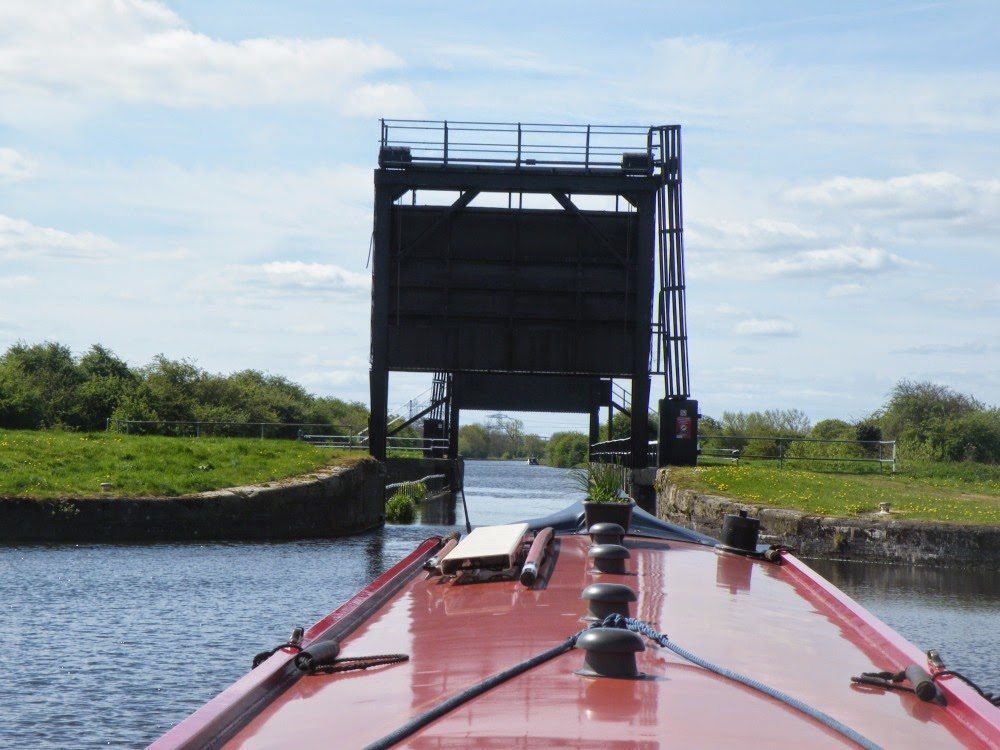
The large electric swing bridges on the New Junction Canal make the scenery reminiscent of Holland. The New Junction is also dead straight for five and a half miles.  You get some idea of this looking under the bridge.

At the Southern end of the New Junction is a second aqueduct, this time over the River Don, whose valley we then followed all the way to Sheffield.


As you cross the Don aqueduct the wash from the boat overflows into the River below.

The huge parish church in Doncaster dominates the view around here.  It was designed by Gilbert Scott and we hope to visit it on our return from Sheffield.

All the locks to Rotheram are nearly 200 feet long, for commercial craft.  This view looks back at Doncaster Lock as Leo comes out of the top gates.  This lock also has a curious kink near the lower gates.

On Monday we moored above Sprotborough Lock and walked up to the village centre.  One house there had some wonderful corbels which had each been carefully picked out and painted, including this one of the devil with bad teeth!

This fine stone building is in fact one side of the Boat Inn.  It is a lovely building, but the pub clearly requires a change of management.  It had run out of beer on a Bank Holiday and had insufficient staff to serve meals in the lovely courtyard outside.


Most of Monday night it rained and we woke up nearly a foot higher as the River Don rose.  Sections of this navigation are on the river itself and when we came to the first lock we were surprised to see that we were cruising on red, which you are advised not to do.

We came under the Conisborough Viaduct which is high above the river and has many arches.  Sadly it is now disused.


The river levels were falling during the day and we were back on green by the evening.  Going under one railway bridge was a bit tricky with fast flowing water but generally the river level was not much of a problem.  However the wind was a different story and, around lunchtime, the herb trough on the roof blew over (other plants were already down below) and with every gust Leo heeled over like a sailing dinghy.  We've never known that happen before and we were going diagonally down some reaches, so we decided to exercise some discretion and stopped for lunch.  Lunch was tempered by sea sickness as Leo rocked from side to side in the gusts.  Afterwards we walked down to the flood lock ahead of us to check the water level.  It was back on amber so we decided to carry on but stop again if the wind was too strong. In fact the afternoon was better and we made it to Eastwood Lock our starting point for the locks into Sheffield.
The Tinsley flight of 11 locks into Sheffield must be booked and a couple of CRT chaps, Nigel and Derek, helped us through. The reason for the booking was partly concern about vandalism (the locks have some very strong anti-vandal locks) and also the need to ensure sufficient water levels.  Here Leo and Christal Haze (our partners for these locks) wait for Rotheram Lock.

Above Rotheram Lock you join the River Don again for a short way and here Leo follows Christal Haze in turning off the river on a cut towards Ickles Lock.  Neither of us expected the mud bank at the turn.

Above Jordan Lock you have to cross the top of a large weir, but the River was down enough not to have to worry about the pull of the weir.

 The lock flight winds about a lot and here we come round the corner to Lock 10 (numbered from the top).  After this one you go under the M1 and pass Meadowhall shopping complex, but there is no time for retail therapy as the climb into Sheffield continues.

There is about 3 miles of flat canal from the top lock into the city.  We passed this broadbeam which has a memorable name (for us as the Wrights anyway).

At the end of the canal is Victoria Quays and this photo shows the very end of the waterway by a huge Grain Warehouse.

After the basin was built and opened in 1819 it became clear there was insufficient warehouse space so they built this 'Straddle Warehouse' over the top of the canal.  Today we took Leo under here and turned round in the basin at the end.

Here you can see Leo moored by Sheaf Quay.


 We decided to spend several days in Sheffield and we are setting off with Christal Haze tomorrow (Saturday) morning down the locks to continue our journey.  We had a lovely evening on Wednesday when we arrived with our friends Nick and Wendy including a meal out at a very good Italian restaurant that they know.  As well as touring around the city we've had a trip by train today to Conisbrough and Rotheram both of which are difficult to visit from the water due to lack of safe moorings on this river navigation.  So here are some highlights:

In Sheffield Cathedral is this wonderful steel (what else in Sheffield?) representation of the nativity.  Intriguingly Joseph rather than Mary is holding the baby and the lowly shepherd has the central position in the tableau.

This intriguing sculpture is called 'the Barking Mad Tree'.  Buttons produce the noise of a dog barking or move various parts of the sculpture.  But it is what the sculpture is made of that was most intriguing (see below).

In this detail you can see that the sculpture is made up of cutlery, again how characteristic of Sheffield.

Sheffield Cathedral is quite a low structure compared with the Town Hall shown here.  This view is taken from the Peace Garden created much more recently.  Each side of the Town Hall is impressive.

A frieze along the front of the Town Hall records trades associated with the city.  This part shows stonemasons on the left and coal miners on the right.

Here is Conisbrough Castle built in the 1180s.  It was advanced for its time with en suite loos, piped water supply and well heated rooms for comfort.  It fell into ruin in the 16th century, but the keep especially looks in a fine state of repair now.

This is the Chantry Chapel on the old bridge over the River Don in Rotheram.  We just had to go to see this.  There are four chapels on river bridges in England and we've now visited all of them on Leo.  The others are at St. Ives (in Cambridgeshire), Wakefield, and Bradford on Avon.


So tomorrow, when hopefully the rain will have stopped and the River Don is not flooding the surrounding countryside, we will set off back down to the flat lands in the Trent Valley.  We hope to go up the tidal Trent mid week, so watch this space.

Friday, 1 May 2015

Wide Waters to Goole

We are now on new waterways for Leo having come out of Leeds following the Aire Valley to Ferrybridge.  Here we turned onto the Knottingley and Goole Canal which we've never travelled before.  This has led us to Goole where we will turn round as we are not venturing out on the scary tidal River Ouse this far down the river.

On Tuesday we left Leeds and moored overnight at Woodlesford which is not very far but it is a nice rural mooring.  On Wednesday we continued to Castleford.


This is the view looking back to Leeds Lock as Leo has come down onto the River Aire.  Helen is closing the gates (they are electrical not manual) before she gets back on.


For those that have watched John Sergeant's TV series "Barging Round Britain", you may remember that he planted a shrub at Woodlesford Lock on the Aire and Calder.  It is a pretty lock and well cared for and he now seems to have a flower bed named after him!


Here we are just leaving Lemonroyd Lock, one of the huge ones on this waterway for commercial craft up to 200 feet long.
Helen is standing at the confluence of the Aire and the Calder at Castleford.  We  had come down the right hand river Aire. That evening we cruised a few miles up the Calder to Fairies Hill to see a couple of Lucy's friends who have a widebeam called 'Polly' there.  It was a nice diversion and we even came away with some fresh eggs from their hens.


There is a good rhyme about Castleford which goes like this:

Castleford Lassies are bonny and fair,
They wash in the Calder and rinse in the Aire.

On Thursday we came through Ferrybridge which has one of the three huge power stations around here and shortly after we turned onto new waters heading for Goole.  We stopped overnight at Pollington which is an attractive village and have come into Goole this morning (Friday).

This is the view coming out of Bulholme Lock at Castleford where you come out on the River Aire again below the weir. The railway bridge you can see is no longer used because mining subsidence here has made it unsafe.  There are nature reserves here on old mine workings.  We even picked up some coal for the stove on Leo!

This is Fairburn Railway bridge which is still used and here we are passing a boat - an unusual event on these northern waterways.

This is looking back to Ferrybridge Power Station which dominates the river here, though at this point we are on a length of canal which by-passes the weir on the River Aire. 

Here we are just reaching the point where we go onto new waters.  Left leads to Bank Dole Lock which takes boats back down onto the River Aire heading to Selby.  We turned right on the wide and straight canal that leads to Goole.

 These are mountains of coal from Kellingley Colliery which we passed close to.

Seen across the fields is Eggborough Power Station, the second of the big three around here.

For completeness the third power station is Drax which we also saw from a distance today.

A kestrel was hovering just beside the canal and we were able to get this reasonably sharp close up.  He really seems intent on scanning the ground for a suitable morsel.

This is Pollington Lock which has no less than four sets of gates to take boats of different sizes.  The first chamber here would take about six Leos but there are three more chambers to extend the length to take enormous vessels that travelled this way as recently as 2012.

Here is the view from Pollington Bridge.  You can see a lonely Leo on the left and the lock beyond.  Just look how straight and wide the canal is.  You can leave the tiller and practically make a cup of tea before coming up to check that the boat is still pointing the right way.  A slight exaggeration, but not much.

The New Junction Canal turns right here and we will be going that way when we come back from Goole, but that is for later.

And here we are coming into the docks at Goole.  After the narrows which marks the end of two miles of dead straight canal, the docks begin, but leisure boats must tie up here unless they are venturing onto the tidal River Ouse (we are not this time).

And here we are moored at Goole.  The barge behind is one of several that form exhibits for the National Waterways Museum which we visited this afternoon.


So far in Goole we have had a well kept and very reasonably priced pint at the Marina Club by the boat and we had lunch at the Waterways Museum and then had a look round.  The museum is well worth a visit and is free (though donations are sought).  We also walked into town this afternoon and were very lucky to see two seagoing ships leaving port.  Goole is a real inland port where coastal ships meet small fry like Leo.  We think it is fascinating.

This Dutch ship, Eems Star fits into Ocean Lock with 20 feet in length to spare.

Helen is standing on the lock gates as a second ship, Fast Wil, turns round ready to come into the lock.

Fast Wil came in and tied up and then a reasonable sized cabin cruiser came in as well.  Fortunately Fast Wil did not slew across the lock as Leo does sometimes, so the cabin cruiser survived the experience and scurried out onto the river as soon as the gates opened. Fast Wil was heading for Poland.

This maelstrom is the result of refilling the lock after Fast Wil had gone.  Hopefully if there was a boat in the lock they would fill it more slowly!

These water towers in the dock area are known as the salt and pepper pots!

This hoist which has been restored was once used to hoist up the Tom Puddings and tip them to release their cargo (usually coal) into ships.  Tom Puddings were small square barges which were towed in long lines by tugs between the coal fields and Goole.  This was an early form of containerisation and was profitable well into the railway age.


So that brings us up to date.  We plan to stay tomorrow in Goole and hope to have a boat trip (not on Leo) around the docks and to visit the large covered market as well as to have a day off boating for a change.

We'll probably move out on Sunday and our next cruising will take us down the New Junction Canal towards Doncaster, Rotheram and Sheffield.  All new waters for Leo.