This posting on our blog covers our journey from Oxford along the
upper Thames to Lechlade where we shall probably stay a few days.
Lechlade or strictly Inglesham a mile or so upstream, is the
navigable limit for boats like Leo.
First some pictures of Tuesday when we spent the day touring Oxford
with the benefit of a guided tour downloaded from the internet.
 |
| This is looking back at the very end of the Oxford Canal. Near the end a lock goes right giving access to the Thames and a dead end branch goes left. The picture shows the end of the branch. It used to go further to a canal basin which is now a car park. There are those who would prefer a canal basin - yes please! |
 |
| This is the Ashmoleum Musuem, seen on our tour. Preferring not to go inside the buildings even when, like this one, they are open, we looked more carefully at the outsides. |
 |
| Our guide seemed particularly interested in the demise of the three Oxford Martyrs - Hugh Latimer and Nicholas Ridley in 1555 and Thomas Cranmer in 1556. The cross in the middle of Broad Street marks the spot where they were burnt at the stake. |
 |
| Here is another Bridge of Sighs connecting two parts of Hertford College with two Japanese tourists taking a picture under it - not many tourists about at the moment so worthy of a photo itself. |
 |
| The distinct lack of tourists leads to this sight of many empty punts on the Cherwell, waiting for customers. |
 |
| We made an exception to our 'stay outside' rule in the case of the Botanical Gardens where we admired these huge pitcher plants in a conservatory. They are carnivorous and with a pitcher this size any insect is fair game. |
 |
| Having a Leo boat we are always on the look out for lions to photograph and found this intriguing grotesque on Magdalen College. Nobody seems to know why the king has his finger in the lion's mouth - one explanation is that the king is removing a bad tooth from the lion's mouth but, whatever the reason, it doesn't seem a very good idea to us. |
On Wednesday we left Oxford:
 |
| We filled up with diesel and set out on the river. In this picture we are going down in Isis Lock which leads to an insignificant backwater called the Sheepwash Channel which in turn connects with the Thames. |
 |
| The route to the river goes under several railway bridges close to Oxford Station, including a swing railway bridge which is no longer used. |
 |
| Here you see Leo cruising past Port Meadow which we had walked round on Monday. We are now heading upstream. The east side of the river, here on the right, is very shallow so you need to stay in the middle. |
 |
| The first lock is Godstow. Many of the Thames locks are manned, particularly in the lower reaches, but this one wasn't. We met a lockie at the next lock - King's Lock - and asked about buying a visitor licence for the Thames, since you used to be able to do this at the locks. Covid has changed all this - you now have to order and pay for a licence over the phone. We have a licence now, but we do wonder if all the visiting boats have done this. |
 |
| Here we are going into Eynsham Lock (which was also manned) with a boat called 'High Hopes' which is now moored in front of us at Lechlade. |
 |
| This rather uninspiring little craft has strong memories for us. In 2012 when we were caught in floods on the Thames at Wallingford, this tug called Tungsten towed our boat and our son's narrowboat, Pas Meche, up the river for miles to the Oxford Canal where we were able to escape the flood after 11 days trapped at Wallingford. Tungsten was skippered by a very laid back chap called Steve. As well as paying him for the service, we left a crate of beer onboard Tungsten after we were rescued. |
 |
| Pinkhill Lock is delightful and was our last lock on Wednesday. |
 |
| We moored on a field below Farmoor Reservoir just above the lock and walked back later to look at the flowers. Many of the Thames locks are kept beautifully and this is no exception. |
 |
| We walked quite a way on the other side of the river and gently up to Sutton and Stanton Harcourt. Sutton has lots of thatched cottages like these and Stanton Harcourt has fine stone houses and a tower known as 'Pope's Tower'. This has nothing to do with the Pope, but refers to Alexander Pope who apparently translated the Iliad when staying in the manor house here. The tower is on private land and we could not get a good picture of it. |
 |
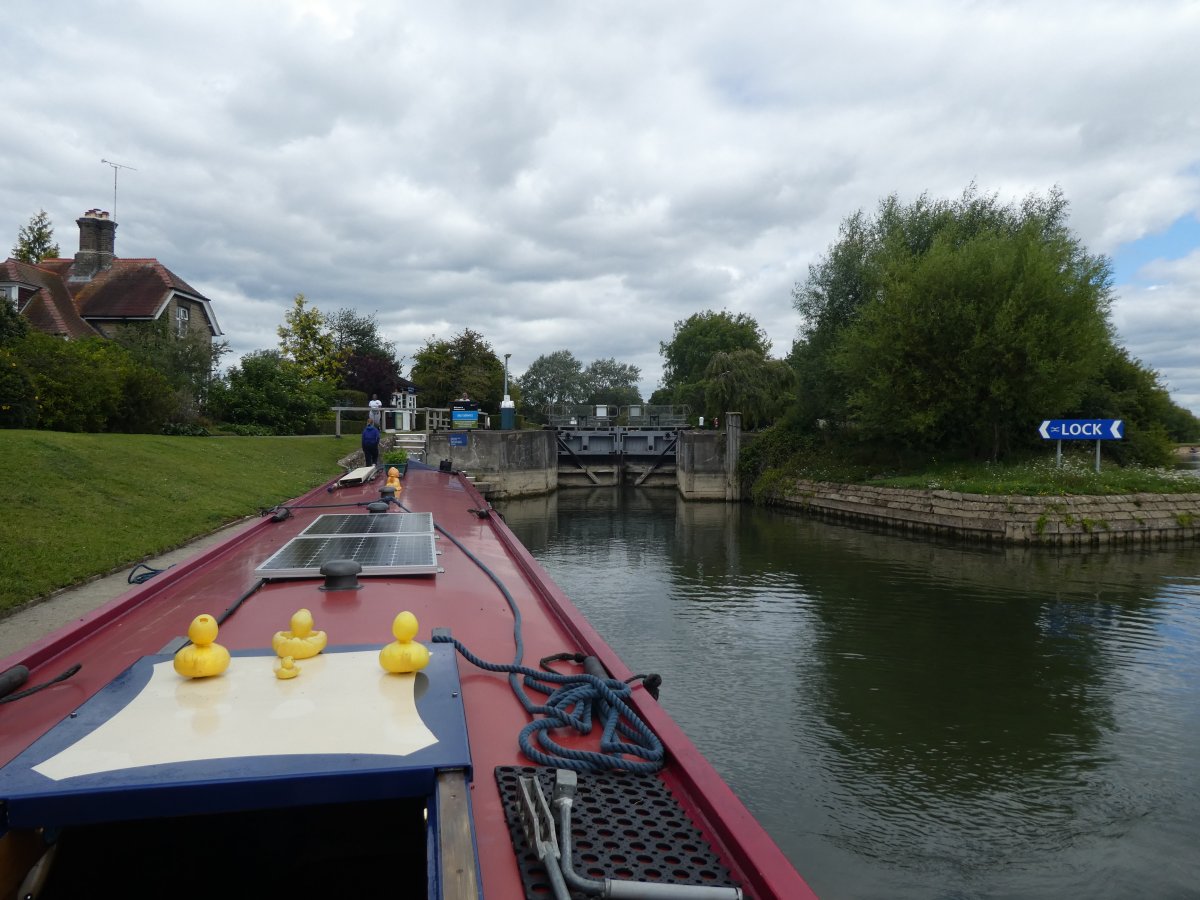
| On Thursday we travelled further up the river and this is Northmoor Lock. All the Thames locks so far have worked perfectly. |
 |
| There are few bridges over the Upper Thames but this one is called Newbridge and has a pub on either side of the river. |
 |
| Here Helen tackles some of the really twisty bends on the way to Shifford Lock. Now we've got to Lechlade we'll be able to rest our arm muscles. |
 |
| Egrets seem to be getting more common. This one was part of a flock of six or so birds by the river. It is a Little Egret but we have also seen Great White Egrets which we've read probably fly over from France. |
 |
| The parasols made us think that Radcot Lock was manned but it wasn't so it was nice that they had arranged for some shade for Helen on what yesterday (Friday 31st) was a very hot day. |
 |
| We passed two groups of swimmers shepherded by boats. These were the pink hats group. The river has been busy with paddleboarders, canoes, swimmers and people jumping in. Some enterprising lads were jumping in the water from a second world war pill box alongside. |
 |
| We've been up here before but we don't remember the many aircraft flying over. We think these come from Brize Norton a bit further east. Perhaps they were training pilots as the planes seemed to go round in anti-clockwise circles. What they'll do if they want to fly clockwise, I don't know! |
 |
| At St John's Lock, which is the last on the Thames, is Old Father Thames shown here. The statue used to be close to the source of the Thames but was subject to vandalism and was brought here, where he has been given a spade. |
 |
| This is just to show you that we also went swimming in the river after we had arrived at Lechlade. Many youngsters were in the water but when it had cleared a bit, the oldsters went in and we relearned the skill of climbing back on the boat afterwards to avoid the sticky gluey mud at the water's edge. Following our example the skippers of the boats either side of us went in too. So did Ian - but no picture. |
 |
| There are lots of swans here and one seems particularly aggressive, that is more aggressive than this aggressive animal normally is. Fortunately the horrid one seems to attack other swans rather than humans. |
After a blistering hot day (34 degrees was forecast and the cabin temperature hit 38), the evening cooled down. We walked up to the Roundhouse where a selection of ambulances and police cars were attending to pick up the casualties from a drunken fight among youths from Swindon. No such problems on the field where we are moored - just families with children and boaters. Oh and a farmer who knocked at the ridiculous hour of 8.30 am this morning to ask for his £5 mooring fee.
We've stayed put today (Saturday 1 August) and may stay tomorrow too. But then we'll be off downstream again.But more about that in the next posting.