Saturday, 6 July 2024

Bridgewater Canal

 After several days of doing lots of locks we arrived at Castlefield Basin in Manchester where we joined the Bridgewater Canal. What is the chief attraction of the Bridgewater? Answer: it has no locks! The Bridgewater Canal was in many ways the first 'proper' canal in the sense of not being just an existing river with locks but a completely separate channel. It was built in the 1760s by Francis Egerton the 3rd Earl of Bridgewater to bring coal from his mines at Worsley into Manchester.

So here is an account of our few days on the Bridgewater:

As we left Castlefield Basin on Friday 28th June this photo was taken looking back. The flats in the foreground are in converted warehouses with the large arches where boats were taken in to unload under cover. The tall blocks behind were certainly not there in Egerton's time and we don't believe they were all here on our last visit 12 years ago.

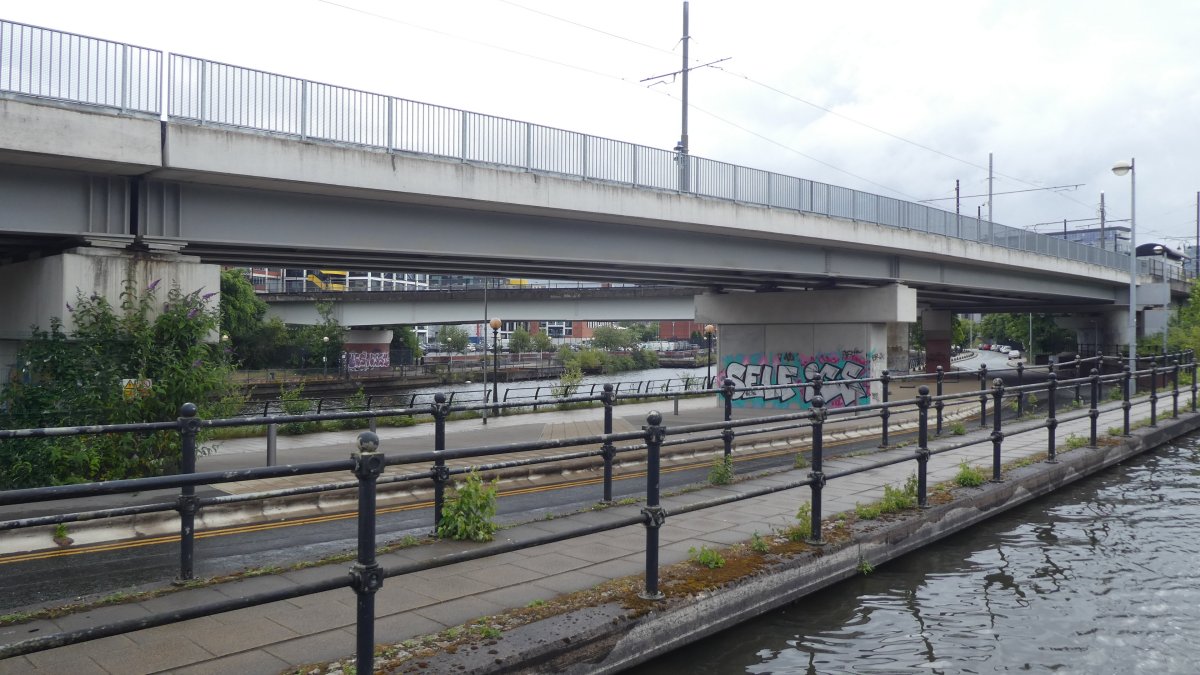
The Bridgewater heads west out of Manchester. The tram line is on the bridge and behind it you can see the Manchester Ship Canal. The Pomona Lock part way along this 3 mile stretch lets boats down from the Bridgewater onto the Ship Canal.

We came straight past the Manchester United Ground.

And soon came to Waters Meeting the next canal junction. To the right the Bridgewater leads to Worsley and Leigh, to the left to Stretford and Sale. Because we were waiting for the locks at Wigan to open after repairs we knew we had plenty of time so we first went left, though ultimately we needed to go right.

We had arranged to meet our friends, Iain and Ann, at Dunham Massey on the following day. This is a National Trust property close to the canal just west of Sale. Ann, Iain and Helen can be spotted in the left foreground.

A herd of fallow deer roam through the parkland.

And this stag was clearly determined to taste the leaves on the lime trees.

On our way back from Dunham Massey we stopped in Sale principally because we've never visited the town before. Though we found little of interest in the town, a 20 minute walk took us to Walkden Gardens which were a delight being divided into many small areas each with a particular character. The picture is of the Japanese Garden.

After lunch we carried on and moored overnight at the Trafford Centre. Those arriving at this huge shopping and entertainment site by car probably do not realise that there is also provision to 'park' your boat there. We are not usually people who frequent shopping centres, but we thought the architecture and atmosphere at the Trafford Centre was marvellous. Particularly the newer section called Trafford Palazzo was mock Roman with marble columns and statues and let in lots of natural light as this picture shows. Alright the palm trees are artificial but the effect was wonderful.

Here is the fountain in the centre of the new bit. The older part was in the same style but less extravagant.

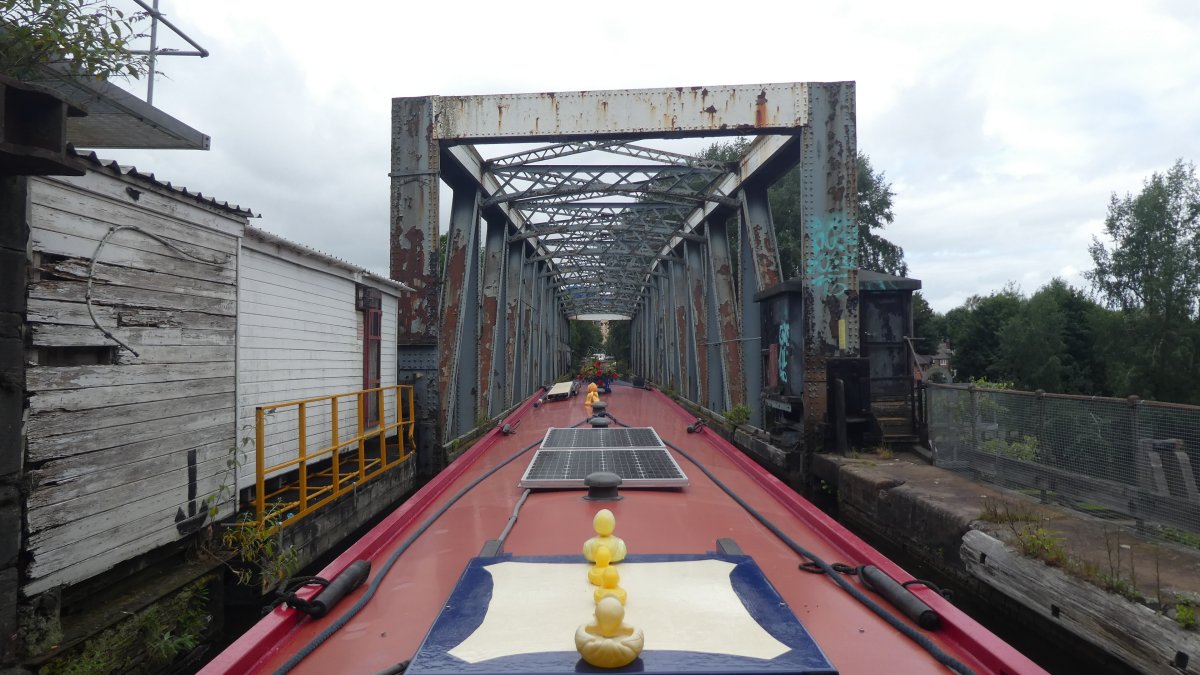
Last Tuesday we carried on and soon crossed one of the wonders of the waterways - the Barton Swing Aqueduct. Built in Victorian times this carries the Bridgewater Canal across the Manchester Ship Canal. It is the only swing aqueduct in the world and it still swings full of water to allow ships to pass underneath. What a marvel of Victorian engineering. The swinging portion full of water weighs 1,450 tons!


Looking west from the Aqueduct you can see the swing road bridge and in the distance the M60 viaduct which is high enough not to need to swing.

This view also to the west shows the central control tower and just this side of it you can see the shelf that the swing aqueduct sits on when open and to the left of that is the buffer at the end of its swing. We have seen both bridges swung when we took a Mersey ferry day trip from Liverpool to Manchester.

Strangely, soon after the Barton Aqueduct you pass a lighthouse at Parrin Lane. We've no idea why it is there but it is a well known landmark.

Soon we came into Worsley shown here. To the right at the junction ahead leads into the coal mines for which the canal was first built. Miles of underground tunnels allowed the coal to be brought out on narrow boats called 'starvationers' and the coal was then transhipped into cargo vessels on the canal heading for Manchester and further afield. The orange colour to the water here is due to iron ore leaching out of the mines.

We moored close to the new RHS Bridgewater gardens and visited them the following day meeting our friends Iain and Ann again. Here is a view of the Chinese Water Gardens.

I'm not sure whether you will have spotted the coot in the previous picture but here is a close up which shows the partially webbed feet rather well.

The peach trees in the glasshouse were producing fruit.

On election day last Thursday we cruised the final section of the Bridgewater Canal. By some bridges on this canal there is often a small crane like the one in the photo. These are for use in lowering the stop planks, here seen alongside into the canal to separate sections of the waterway if there is a breach.

This part of the Bridgewater was built to link up with the Leigh branch of the Leeds and Liverpool Canal and at this bridge the two canals meet end to end. The sign marks the transition back to Canal and River Trust waters. CRT licence holders like Leo can take a temporary transit licence on the Bridgewater free of charge on a reciprocal basis between the two concerns.

So here ends our cruising on the Bridgewater Canal. The next posting will follow in a few days and will cover our ascent of the 21 lock flight at Wigan as we set out on our crossing of the Pennines on the Leeds and Liverpool Canal.

Friday, 28 June 2024

The Infamous Rochdale Nine

 As promised, here is our account of travelling down the 9 locks of the Rochdale Canal that take boats down through the centre of Manchester from the Piccadilly area at the top to Deansgate and Castlefield at the bottom. These locks carry a bit of a reputation as two of them lie underneath modern high-rise buildings where in the gloom druggies and prostitutes are said to do their business. The canal also passes parallel to Canal Street which is now the centre of the gay community in the city. This is the first time we have taken Leo this way and there are not that many places left where Leo hasn't been. So here is the story of our 'first' for 2024:

On Tuesday night we stayed in Piccadilly village so it was on Wednesday morning that we went to the very end of the Ashton Canal where it meets a 'T' junction with the Rochdale. To the right lies an ascent over the Pennines. To the left lie the 9 locks. The picture shows the first lock, number 84 with Leo entering. Note that we are now in broad lock land as 2 narrowboats would fit side by side in these locks.

Once down lock 84 you are in a cavernous space below buildings for the next two locks. The pillars in front of Leo support the tall buildings above. Fluorescent lights allow boaters to see what they are doing.

Here Leo is in lock 85. The towpath, which is not continuous through the 9 locks, carries on down a ramp on the left.

Helen took this photo of Leo coming in to Lock 85. Best not to ask what is floating on the water!

After the two 'underground' locks we came to lock 87 which is in the open air and right alongside Canal Street. Note how the wall is carved out to allow boaters to operate the lock gate.

Sometimes there is just not enough space for the lock beam, so here an ingenious alternative solution uses a chain linkage powered through a gear box by your windlass to pull the gate open or closed. The steep steps beyond the apparatus lead down to a landing where the lock crew (aka Helen) has to get back onboard as there is no towpath to the next lock.

A narrow channel between modern buildings and an old warehouse lead on to lock 88.

And here Leo is in lock 88 before Helen opened the downstream paddles to let the water out. Another subterranean section leads out of this lock under the white building.

Nearly there! Leo is shown coming out of lock 91 which is shallower than most of them. The diagonal staircase leads up to Deansgate Tram stop.

The bottom lock no 92 has a traditional lock keeper's cottage which looks out of place among all the high rise modern buildings. Ian is using our alternative to a bow thruster, namely brawn to push Leo to the other side of the lock.

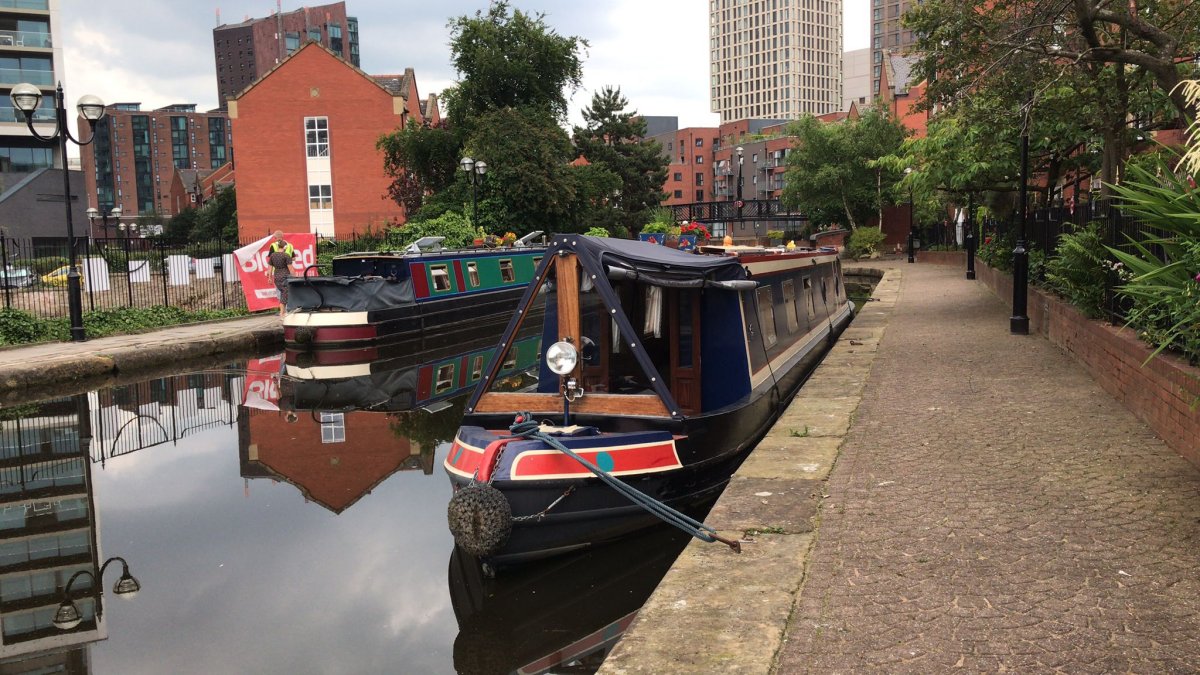
Below the locks there are opportunities to moor in basins to left and right. Because a festival was to take place to the right, we went left into Castlefield Basin shown in the picture where we found a mooring. Handily you can walk across from Lock 92 to see if there are spaces.

Fortunately you can turn a boat at the end of the basin, so here Leo is safely moored facing to go out after a couple of days exploring some of the city sights.

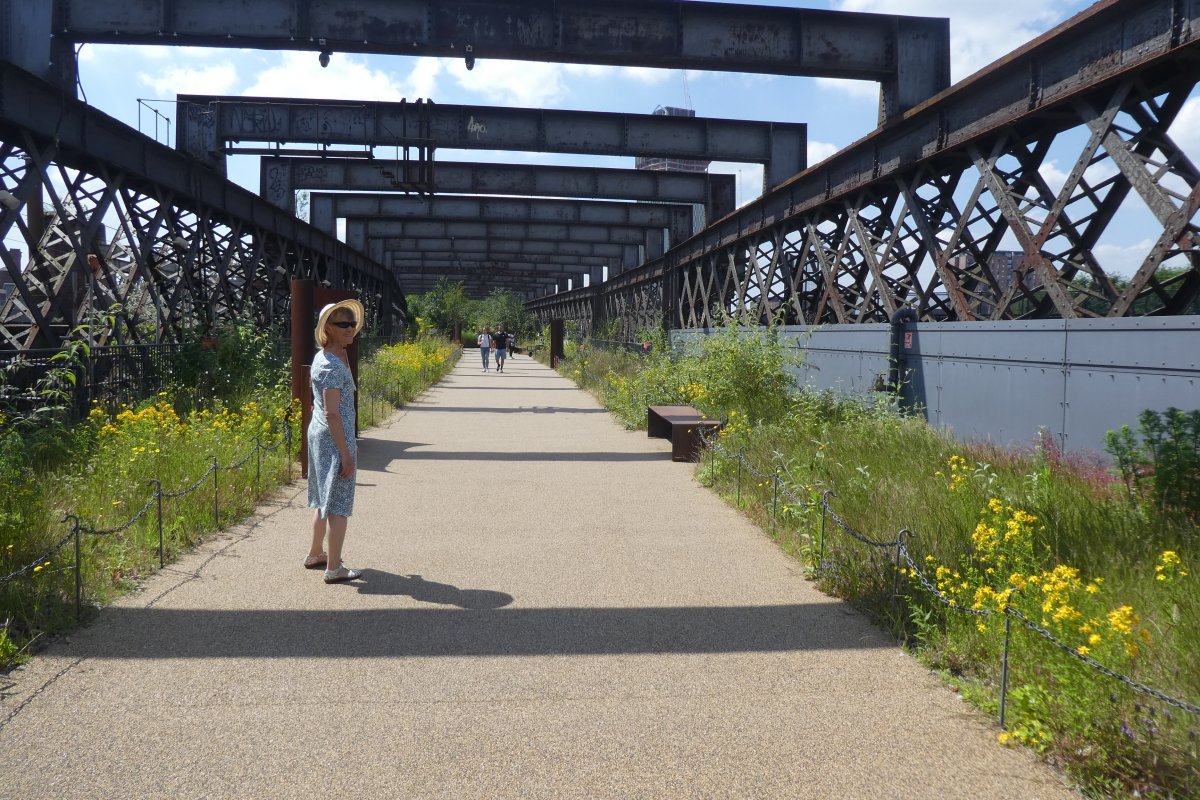
One that we did want to see was an old railway viaduct now owned by the National Trust and planted with both wild and cultivated plants. It was pretty hot on the day we arrived but there were some trees for shade in the garden in the sky and the NT building at the end is air conditioned.


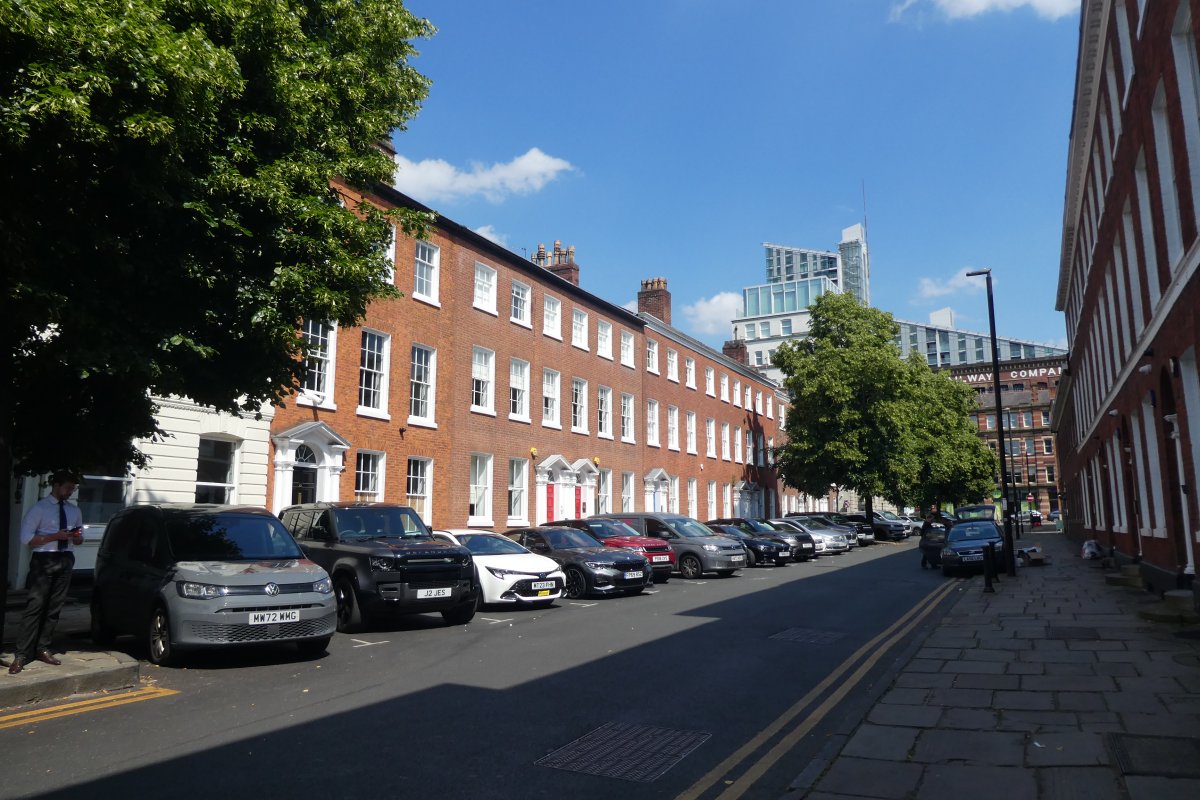
We haven't previously found any attractive streets of old buildings in Manchester but this is St John Street which brought back memories of Bath.

And here is the John Rylands Library building, a wonderfully exuberant Victorian Gothic monument to the philanthropy of Rylands and his cuban wife Enriqueta. Rylands made his money in cotton. Manchester is sometimes referred to as 'Cottonopolis'.

On Thursday we walked along the Bridgewater Canal to Salford Quays. As we left the Bridgewater we came upon this intriguing crane hook suspended from nowhere. Behind is a warehouse built in 1932 for incoming cotton arriving by rail rather than canal.

At Salford Quays, we particularly wanted to visit the Imperial War Museum North which opened in July 2022. We were frankly disappointed. It is a very individual peculiar shaped modern building but inside there was no natural light, bizarrely sloping floors and leaning walls which made us both feel a bit dizzy at times. There was lots of space inside but remarkably few exhibits. One that did affect us was this steel window from one of the Twin Towers and the accompanying recorded accounts from some survivors. But overall probably best avoided, though it is free! We much preferred the Lowry (also free!) on the other side of the Manchester Ship Canal.

We walked over the Millenium Lift Bridge and this view was taken from the bridge looking towards Liverpool. The BBC Salford building is on the right.

We are now on the Bridgewater Canal and we'll tell you more about that another time. It has one significant advantage after several days doing lots of locks - it doesn't have any!

Thursday, 27 June 2024

The Ashton Canal

 In an effort to catch up with our speedy passing of canal junctions, here is our account of travel down the 6 or so miles of the Ashton Canal into Manchester:

You may remember that we came to the end of the Peak Forest Canal at Dukinfield Junction and there turned left onto the Ashton Canal. The Ashton has a reputation for passing through rather unsavoury parts of the outskirts of Manchester but we found that things have much improved in the 12 years since we last passed this way. Nevertheless we decided not to chance mooring overnight on the Canal and instead booked a night in the small marina at Droylsden. You might be able to make out Leo fourth from the right on the moorings. We spent the afternoon walking the three and a half miles down the Canal into  Manchester and getting the tram back.
There are 18 locks down into Manchester and here is the first one close by the marina. Originally there were two locks side by side but the right hand one is no longer operating.

Here is Leo going down in the first lock.

Below the first lock (actually this is no 18 as they are numbered from the bottom), is a boathouse seen here on the left looking back.

Early on in the flight we had problems with a very low pound and, from then on, we positioned Leo against the top gate of each lock with the engine at low revs pushing against the gate. This meant we did not have to moor by the side of the canal where it was likely to be too shallow. Getting stuff round the prop was also a problem and Ian had three trips down the weed hatch to clear things. As well as a lump of timber that stalled the engine we caught a fleece, a pair of knickers, swimming trunks, plastic waste and lots of weed!

By the new Co-op Live arena at lock 5 a man-powered butty passed us coming up.

There is a lot of new development going on at the Etihad Stadium. No wonder football teams are so rich.

Though it now seems safer, no-one would describe the surroundings on the Ashton as pretty!

A new bridge has been put in to access the Velodrome.


Here we are coming into the city towards the bottom at Lock 1. Manchester has a lot more high rise buildings since we were last here and yet more are being built.

Here is Leo waiting for Lock 1. The low rise development beside the Canal below the lock is Piccadilly village which dates from 1990 and was where we were planning to spend the night.

And our good fortune continued as there was space for us on the offside away from the towpath. This is outside a residential development and ordinarily might be marked 'Private: No Mooring' but in fact they permit boats to moor for 24 hours. You cannot however get out from the development to the rest of the world. However a quiet afternoon suited us fine.

This splendid rose was in the private estate gardens of Piccadilly village which visiting boaters can access even if they can't get out of the development through the locked gate.

So now we were positioned in a great place to take on the 9 final locks of the Rochdale Canal into the bottom end of Manchester at Castlefields. These are known as the 'Rochdale 9', carry a fearsome reputation with boaters and we had never tackled these locks in Leo until now. But that story will have to wait for the next posting on this blog in the next day or so.