This is the second instalment in our endeavours to get the blog up to date. Tonight (Saturday 12th September) we are at Hillmorton on the edge of Rugby and this is the story of how we got here from Cosgrove where at theend of last post.
This is Soloman's Bridge at Cosgrove which is unique among canal bridges in style and was built in 1800, soon after the canal was finished. No-one seems to know why such a pretty structure was chosen.
The fields north of Cosgrove were surrounded by a fallow strip and here the strip has been planted with sunflowers. The view is reminiscent of northern France.
About six miles north of Cosgrove we came to the bottom of the seven locks up to Stoke Bruerne. We moored at the top on Tuesday (8th September). Here we are waiting in the penultimate lock for the top lock to be emptied and the descending boats to come out so that we can go in. We are locking with a boat called Chelonian and owners Dave and Arran. It's always best to share the wide locks if you can: the whole exercise becomes easier.
And here we are coming out of the top lock. Stoke Bruerne is a real canal village with lots of interest. On the right is the old working boat, Sculptor, that does trips. We moored here and explored on foot up to the Blisworth Tunnel, which is barely half a mile from the top lock, and across fields to Shutlanger.
This is the south portal of Blisworth Tunnel, the third longest canal tunnel in the UK at about a mile and three quarters. Fortunately it is wide enough for two narrowboats to pass each other. Though it might look as if the lady in the light blue jeans is going to throw her child in the canal or jump in with him, she didn't!
Stoke Bruerne has many thatched properties like these around the village green. It also has a couple of pubs, an indian restaurant and an ice cream seller. What more could you want?
On Wednesday morning we set off through Blisworth Tunnel. We had a late start because Ian was servicing the engine. The village of Blisworth is on the north side of the tunnel. We hadn't visited the village before and, as we needed some gin to make more sloe gin, we moored for a while and walked in. The picture is of Blisworth Mill. It really looks as if we are back in the north!
Blisworth was a delight with many thatched cottages, a church, a pub and even a small shop which we patronised. The honey coloured stone in this part of Northamptonshire makes all the buildings blend well together and is very attractive. Some buildings were even built with horizontal stripes of this stone and a lighter coloured one.
Someone in Blisworth has been having fun with this litter bin by the canal. It shows a narrowboat coming out of the tunnel.
As we came back to the canal from the village this boat went past. It is called 'Leo no 2' and is a sister ship to ours, being also built by Mick Wilson. Though it carries the name of Kathryn Doddington she has now sold it to new owners. Strangely we had met Kathryn the previous day in Stoke Bruerne.
Not far beyond Blisworth we came to Gayton Junction where a branch of the canal descends 17 narrow locks to Northampton where boats can join the River Nene to Peterborough and the sea. The sign shows that we are now 77 miles from Brentford with only 16 and a half miles left to reach Braunston. We didn't go down the locks to Northampton this time and in fact discovered later that one of the pounds close to Northampton had been drained by unscrupulous miscreants and the canal branch was closed that day while staff worked to restore the water levels.
On Wednesday we moored near Nether Heyford and had a good walk into that village and across fields to Bugbrooke featured in this photo. You can see here the lovely honey coloured stone again. It looks even better in the sunshine. We called at the Baker's Arms and enjoyed tea in the garden.
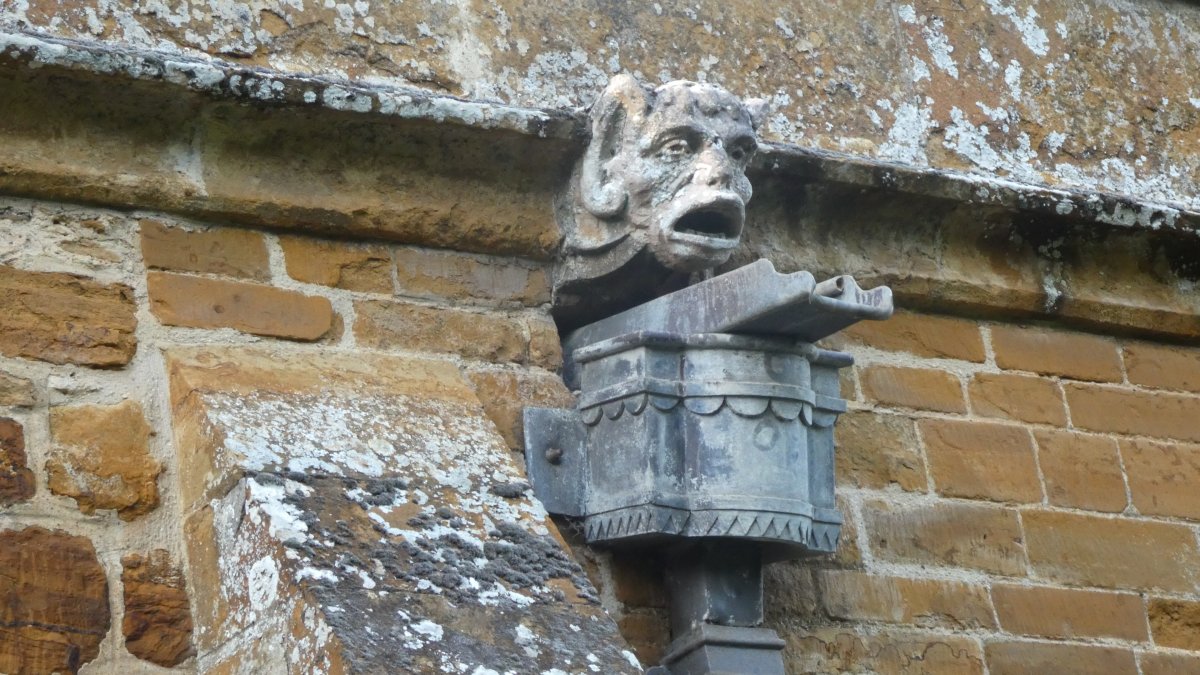
On the way back to Leo we looked at Bugbrooke Church and admired the gargoyles especially this rather devillish fellow.
On Thursday we passed through Weedon. We have stopped here before and there is much of interest. The canal crosses an aqueduct over the River Nene which is very small here and there is an old army ordnance depot supplied by a canal branch. This was built in the Napoleonic wars and the buildings and canal branch remain, albeit the railway has cut off its water link to the main canal. A few miles further north we came to the Buckby locks. The bottom lock (of seven) is shown in the photo where we are following a Black Prince hire boat we shared the locks with. They had done five hire trips and Paul was a very competent helmsman so there were no awkward moments with novice boaters.

We moored overnight on Thursday in the long pound below the top lock and spent the afternoon catching up with jobs - clearing out, cleaning and painting the gas locker at the front of the boat. As a result of the grit blasting we had done during the winter the locker had filled up with ball bearings which had rusted in situ making quite an unsightly mess. Ian had been putting off the day of sorting this out, chiefly because some contortions are required to get sufficient of his upper body into the tiny hole to reach the furthest parts of the locker. Partly because we had to leave the gas cylinders out of the locker and so no cooking was possible, we ate a meal at the New Inn above the next lock - the first time we have eaten out indoors since the Covid problems started.
This picture was taken on Friday morning. First thing: more jobs - changing the oil in the engine and the oil and fuel filters. See, it is not all fun and games this boating lark! Once that was done we went up the final lock at Buckby and this picture shows Norton Junction which is within a few hundred yards of the top lock. At this point we had come full circle, having passed through this junction last on 17 July. Just beyond the house on the right the Leicester Arm leads north to Leicester and the Trent and it was from that direction we had come in July. To the left of the willow tree is the continuation of the Grand Union through Braunston Tunnel and into Braunston.
Just the other side of the tunnel we reached Braunston top lock, the first of six that took us down to the village. Braunston is pretty much the centre of the canal network in England with routes going north and south, east and west.
Because of its central position Braunston is always busy and Friday was no exception as this picture shows. We had barely left the bottom lock than the way forward was completely blocked by a pair of boats, breasted up side by side, coming towards us through the little space that was left between hire boats moored on the left and boatyard boats on the right. As always on the waterways patience was required and all was sorted out in a few minutes and on we went.
Moorings through Braunston were all full and so we pressed on. The fine twin bridges in the picture are over two arms of the combined Oxford and Grand Union Canals heading left towards Birmingham and Oxford. We had gone that way in July, but our way on Friday lay to the right which is the North Oxford Canal towards Rugby and Coventry.
Finally on Friday we moored just outside the hustle of Braunston on a nice country mooring as shown in this photo. Behind the boat you can just see the spire of Braunston Church.
While we were moored at Buckby we had visited a canalside shop and decided to buy two beautifully painted plant troughs. The flowers are a bit sad now but the trough looks great. The troughs are made by a chap called Frank who lives near Hillmorton and painted by the shopkeeper, Tracy. They should look good next year when both are planted up.
This was taken at night from our moorings about a mile away of the spire of Braunston Church. It seemed to float above the trees.
And here is the view in the morning.
The countryside north of Braunston is delightfully rural with extensive views of low hills from the canal. A few miles on we came to Hillmorton and this is a view of Hillmorton Wharf with an attractive group of buildings.
We then came down the three Hillmorton Locks and are now moored at the bottom of the locks. Hillmorton locks are unusual in having three pairs of narrow locks. The locks were doubled in the 1840s to speed traffic through what was then a bottleneck. Here Leo is coming towards the top lock with Helen winding up the paddles to fill it.
Here you can see the two locks side by side. Leo on the right is going down, the other boat is going up.
And here we are coming to the bottom pair of locks.
Once we were moored below the locks we walked back up and had lunch at the canalside cafe, sitting outside this time. This arm of the canal between locks 2 and 3 is now used by a boatyard but was built for coal to be unloaded to power steam pumps which pumped water back up the lock flight.
Interestingly the paired locks at Hillmorton had paddles connecting across between them. This meant that each lock could act as a side pound to its paired lock. So a boat going down would donate its water into the opposite lock to raise a boat going up. Once the levels were the same (at the half way point), the interconnecting paddles were closed and the locks operated normally. This saved half a lock of water for each pair of boats. Pretty cunning these Victorians.
So that's about it and has brought us up to date. From here our way lies north towards Coventry and then on towards Nottingham where our travels for this year will come to an end for the winter. Already the leaves are falling: it's been a short boating season. We've had a lovely day today and to cap it off our friends John and Ali on Triskaideka came past this afternoon heading up the locks. It was good to see them again and to have a brief catch up with Ali on the towpath and John on Triskaideka alongside Leo.