Monday, 16 May 2016

Right to the very End of the Lancaster Canal

Not only have we now cruised to Tewitfield, which is the present navigable limit of the Canal but yesterday we cycled the remaining 14 miles of the original course of the canal to Kendal, so we can truly say we have reached the end of the Canal.  However let's go back to where we left off.  On Thursday we walked into Morecombe along the sea front from Hest Bank where Leo was moored.

Here is Helen on the seafront at Morecombe doing 'Bring Me Sunshine' with Eric Morecombe.  His statue and little garden is very well designed and we thought it was just right as a memorial to the man.

On Stone Quay, where we patronised a good cafe, there is a series of plaques about birds with poems or jokes, like this one.

At the very end of Stone Quay is Trafalgar Quay which is the best Morecombe now has for a pier sticking out into the Bay with good views of the Lake District on the other side.


We caught a bus back from Morecombe and then cruised on just a short distance to Bolton le Sands which is another nice place right by the sea, though here a salt marsh prevents you getting up close to the water.  On Friday we carried on to Carnforth and moored overnight in the Capernwray Arm.

As you come through Hest Bank the canal comes round a bend and suddenly you are on an embankment with views of Morecombe Bay below you.

The section of canal to Carnforth continues to give excellent views of the sea.  Here we are looking across the bay to Grange over Sands with the Coniston Fells in the background to the right.

Carnforth Station is famous for its starring role in the film 'Brief Encounter'.  On the Station is a fine museum and information about the film and its director, David Lean.

This is the Refreshment Rooms at the Station which have been restored to the decor in the film.  So we had a tea and a coffee to pretend that we were Trevor Howard and Celia Johnson.

Capernwray Arm is a short branch off the canal which originally served a quarry.  It is now a delightful secluded stretch of water through the trees with a sizeable pond at the end.  There is even a pontoon to moor to.  In the picture you can just see Leo peeping into view.

This shot was taken where the Arm branches off the canal.  The red boat is on the canal and the blue one is just at the start of the Arm.


On Saturday we cautiously reversed past several other moored boats and then carried on along the canal.  Though the Arm was quite deep, the entrance, like most of this Canal, was rather shallow and reversing the last bit onto the Canal was pretty tricky.  Only a mile away we had to turn round at the navigable limit at Tewitfield.

Here is the end of the Canal.  Turning round for us was not easy as a couple of hire boats were moored at the Service Block restricting the winding hole.  By lifting the rear fender we just managed to turn round next to some private moorings.

The end of the Canal is right next to the M6.  When I say right next to the motorway  I really do mean it.  Here you can see that the coach is passing within 20 feet of the end of the Canal!


This boat was moored right at the end of the Canal.  I've called it the Clockwork Boat.  The effect of the reflection of the red painted top of the rudder makes it look as if it has a key at the stern to wind it up!!


Here is the signpost at the end.  Note that to the right it shows Burton and Kendal, the latter being fifteen and a half miles further.  Kendal is where the canal originally ended when it was completed in 1819.  A good path is signposted all the way so we decided to cycle this the following day.


So it was out with the Bromptons and a packed lunch in the cycle bag.


The Canal is blocked by the embankment of a road but the other side the Canal is in water and ascends 8 locks of the Tewitfield flight to climb 75 feet to its original summit level.  The stonework of the  locks is in fine condition though there are no gates.

Here we are looking south from Lock 5 and you can see the motorway on the right.

Even the mileposts are still there, this one saying 14 miles to Lancaster and, on the other side, 13 miles to Kendal.

It will be wonderful when this section of canal is restored to use.  The views and the scenery are first class.  Cycling along the first 8 miles which are in water, you would think it was a functioning canal.  That is until you come to the next major road crossing and find just an underground culvert connecting across.

This is the view of Holme Mills from the Canal.  In the distance are the mountains of the Lake District.

There was no wind for much of Sunday and the reflections were fantastic.

Here is one of the crossings of the  M6.  Just beyond Helen the canal comes to an end for fifty yards and then resumes on the other side.  Here the path steps sideways to use the pavement by a main road to cross under the motorway.

Under the next bridge we found a group of people waiting for a trip boat.  Water Witch is owned by the Lancaster Canal Trust which is working to restore this section of  canal and the trip boat acts as a fund raiser.

For half a mile or so the path leaves the canal.  This is because Stainton Aqueduct was damaged by the Christmas Floods and is now unsafe.  This view shows the problem and was taken from a distance on the diversion.  As if the restorers didn't have enough problems!

Soon after Stainton the water ends and the canal is just a ditch.  However its course is easily followed and soon we met the Hincaster Tunnel which takes the canal through a hill into the valley of the River Kent.  In the picture to the left of the Canal tunnel is a horse tunnel that led to a path over the hill for the barge horses and, now, for us.

Here is the horse path which has some fine stone bridges along it.  The hill rises 70 - 80 feet above the canal.

Soon after the tunnel we found this fairy house in a tree.  Some local person has been having fun.

Although some of the dry canal is obvious on the ground, for other sections we were following a path across a field with no sign of the canal until you come across a canal bridge in the middle of the field.

This bridge in particular stands in splendid isolation in the middle of a fairly flat field.  Where has the canal gone?

By contrast this section looks as if you could fill it with water and it would be instantly navigable.   Here you can see an old winding hole for turning boats just beyond the tree on the right.

The last 4 miles seemed to go on for ever and there were a lot of stiles to lift the bikes over.  Finally coming into Kendal the path becomes a recognised cycleway with a tarmac surface.

The Canal ended at 'Canal Head' where there was a wharf for unloading boats.  Today this has become the local council household refuse tip.  A bit sad really for our ride to finish at the local tip!
Having reached Kendal we looked in vain and asked a couple of locals for a tea shop to celebrate our successful 'navigation' of the Northern Reaches of the Lancaster Canal.  There being no prospect of tea we caught the bus back with our folded bikes wrapped in bin bags (we had been told that the bus company prefer them wrapped).  Instead of tea we had celebratory pints at the Longlands Inn at Tewitfield.  Incidentally we learned that 'Tewit' is the local name for the Lapwing which we know by the alternative name of 'Peewit'.

Tonight we are at Hest Bank and over the next few days we will be heading back south.  Our appointment with the Ribble Link to make our return to the rest of the canal system is a week today, Monday 23 May, so keep your fingers crossed.

Wednesday, 11 May 2016

Trips to the Seaside and More

Sorry that we haven't managed to do a posting to this blog for a while but there is always lots to do on the waterways and we just don't seem to have had time.

The Lancaster Canal is pleasantly rural for most of the way.  On Friday we cruised on to Garstang where, in the evening, our daughter Lucy and her friend Becca came to join us for the weekend. 

We've seen quite a lot of bluebells this year including this fine carpet in a wood next to the canal.

There are some fine aqueducts on the Lancaster Canal for the most part designed by John Rennie.  This one is over the River Wyre.  We noticed the similarity with the Dundas and Avoncliff aqueducts on the Kennet and Avon and then discovered that he designed them as well.

This is the top of the Wyre Aqueduct.  We liked Garstang and did some shopping there to stock up with our visitors coming.


On Saturday we made good use of our new crew in going down the six locks to Glasson Dock which are on a branch of the canal linking with the sea.

Both Lucy and Becca had birthdays recently so Lucy had baked a cake and very tasty it was too.

Here is Lucy at the helm in the top lock of the Glasson six.  Just the other side of the bridge is the main canal going right to Garstang and left to Lancaster.

We were fortunate to catch up Ian and Tracy on Tangled up in Blue (a Bob Dylan song in case you want to know where the name came from).  So we shared the last three locks.  Here we are coming out into Glasson Basin, a large stretch of water linked by locks through the docks to the sea.

 Once moored this was the view through our windows.  You don't usually see lots of yachts from Leo, but these can go out to sea from this marina.  We didn't follow them!


On Sunday Leo stayed put and we went for a pleasant walk along the sea front in the morning with Lucy and Becca.  It is novel and fun to walk down to the sea from a narrowboat.

Glasson Dock has a 'hill' which rises sufficiently to give a good view over the River Lune  estuary and North to the Lake District though visibility was not very good.  The white building is Heysham Power Station.

And here we are down by the sea.  As we walked along the tide was coming in.  They say that it comes in here at the speed of a galloping horse.  Well it was not that fast but it did flow over the sand and mud at the speed of a mountain stream.

As a change from Grey Herons on the canal we saw this Little Egret on the shore.

This is the remains of Cockersand Abbey that we passed on the coast path.  Another victim of Henry VIII.

It was really hot on Sunday and we had lunch by the boat before Lucy and Becca had to leave us by taxi back to Garstang and then a long drive home.  It was lovely to see them.

Glasson Dock is still an active port with the bigger ships like this one staying on the river outside the dock and going aground at low tide.  Grain and furnace slack were the cargoes we saw being unloaded.


After saying goodbye to our visitors we spent Sunday afternoon going for a cycle ride up the cycle track by the River Lune part way to Lancaster.  So an active day of walking in the morning and cycling in the afternoon.

On Monday we joined Tangled up in Blue in going back up the six locks (these are the only locks on the Lancaster Canal if you don't count those on the Ribble Link).

Here is Tangled up in Blue following us into the first lock.

And here we both are in the top lock.  From here they turned right heading South because they cross back on the Ribble Link on Wednesday, whereas we turned left heading towards Lancaster.

Here is Leo moored just before the Water Witch pub which was very well patronised as it was a hot though windy afternoon.


We stayed two nights in Lancaster enjoying the sights.

We walked downhill from the Canal to the River Lune which is tidal at this point.  The picture is of the Millenium footbridge which allows pedestrians and cyclists to cross to the northern part of the city and on towards Morecombe.

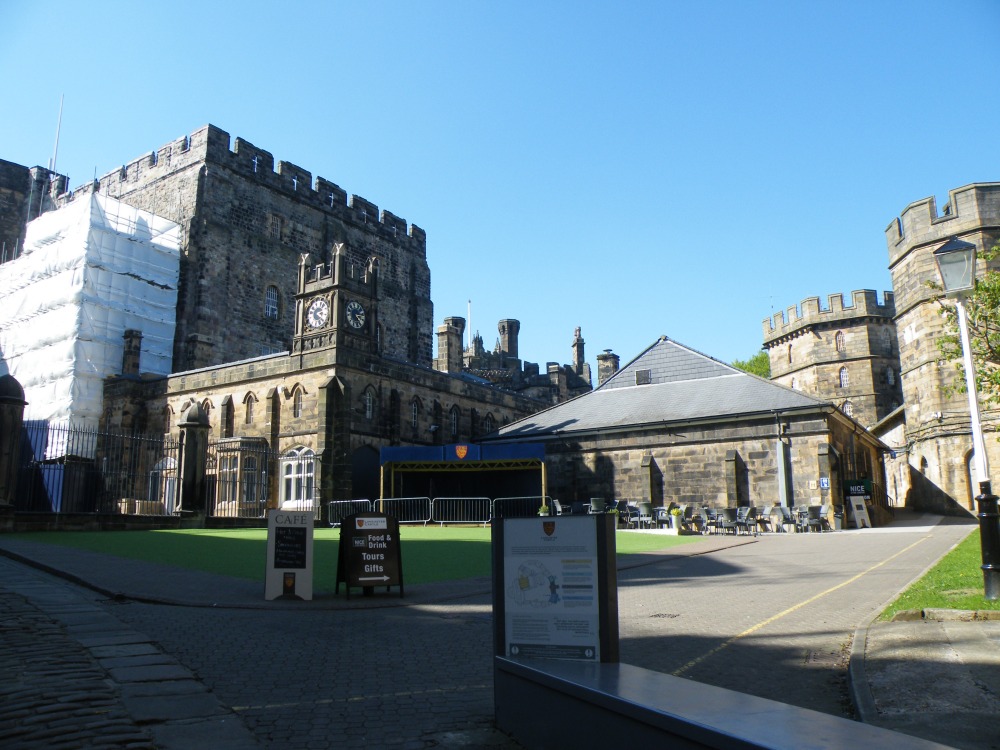
Lancaster Castle was originally Norman but was extended 200 years ago and, until recently, was used as a prison.  It is still a functioning Courthouse and is famous for two trials, that of the Pendle Witches in 1612 and that of the Birmingham Six in 1975.  The convictions of the latter were quashed in 1991 but it would have been a bit late to reprieve the witches who were executed.

This is the John of Gaunt Gatehouse which is the entrance to the Castle.  We had a tour of the Castle yesterday (Tuesday) which was interesting and entertaining and extended to the modern court facilities as well as the Drop Room which led to the scaffold.

In Dalton Square is this huge monument to Victoria.  Round the base are reliefs of many prominent Victorians comprising politicians, scientists, novelists and artists.

The Priory Church stands on the hill next to the Castle and from there you can look across the town to the Ashton Memorial shown here.  We had seen this distinctive building from the M6 but had never visited it before.

This is the inside of Atkinsons Coffee Shop.  A real old fashioned traditional coffee importer and seller, Atkinsons has now opened a novel and popular cafe where we had lunch and two varieties of coffee served in curious retorts.

After visiting the Judges Lodgings, a fine Georgian House used by judges visiting for the Assizes, we walked across town to Williamson Park and the Ashton Memorial.  This was built in 1906-9 and given with the park to the town by Williamson who made his fortune manufacturing lino.   The park and gardens were originally moorland where criminals were executed.

The view from the Ashton Memorial is pretty good even though visibility was poor.  Here you can see the Priory Church on the right of centre and the Castle to its left.

The park has been restored in recent years, particularly this lake.  The fresh blossom was lovely.


After a couple of days looking round Lancaster we cruised on this morning to Hest Bank, crossing en route the Lune Aqueduct which is a truly splendid highlight of the waterways and another testament to the work of John Rennie.

This aqueduct was built in the late 1700s and has a grace and lightness that belies the fact that it carries a canal.  The canal is 60 feet above the river so this is quite a feat of engineering.

Here is the view from Leo while crossing the aqueduct looking down this impressive river.

At Hest Bank the canal runs within a few hundred yards of the sea and this is the view from the canal of Morecombe Bay as we approached Hest Bank.

After a hard afternoon of washing and polishing the boat we walked down to the sea.  This view is looking south towards Morecombe.  Signs here warn you not to venture onto the sands without a guide because of fast rising tides and quicksands.  This is where the cockle pickers died not many years ago.


Tomorrow we plan to catch the bus into Morecombe where Ian went for a couple of family holidays as a child.  Over the next few days we will be travelling on to the end of the navigation at Tewitfield which is now only 7 miles away.  We plan a number of excursions too, so watch this space.