Wednesday, 1 June 2016

Back to Narrow Locks at last

We are in Middlewich having come up our first narrow (seven feet wide) locks since July last year.  It was a real delight.  Narrow locks are just Leo's cup of tea.

The last posting was from the Bridgewater Canal, so I'll bring you up to date from there.  On Saturday we just cruised for about half an hour and moored on the Bollington Underbridge.  This is a lovely spot that gives access by a track and a footpath to the National Trust property, Dunham Massey nearby.
Here is the house with some wild fallow deer in the foreground.  Last year we visited Dunham Massey and they were doing a special presentation about its role in the first world war.  Though we enjoyed that, we hoped we might see more of the house this time.  However they had found another story to portray of the 7th Earl who married a circus performer!

This stone is one of several recording poems written by Canadian and other soldiers billeted at Dunham Massey in WW1.  Its boating message seemed right for our journey.

This is the water mill at Dunham Massey.  It still works and grinds grain to make wholemeal flour.


On Sunday we carried on through Lymm and the built up area around Stockton Heath.

Lymm is a delightful though very popular spot on the Bridgewater Canal.

From near to where we moored (near Moore - how appropriate), we could see the Runcorn-Widnes bridge in the distance.


On Monday we left the Bridgewater behind and joined the Trent and Mersey Canal at the start of Preston Brook Tunnel.

Here we are waiting for our time slot to go through the tunnel which is about three quarters of a mile long.  It is only wide enough for one boat at a time and going south you are allowed through on the half hour, with boats going the other way at the hour.

Here is the southern end of the tunnel with these two houses built over the top.  Almost immediately there is a stop lock, the first lock we had met for nearly 40 miles.

The next section of canal is a delight giving views down into the valley of the River Weaver.  Here you can see Acton Swing Bridge which crosses the Weaver and swings for any high vessels.

There are a couple of short tunnels on this stretch and here you can just see the light of a boat following us through Saltersford Tunnel.

We moored overnight close to the Anderton Boat Lift which allows boats to pass 50 feet up or down between the River Weaver below and the Trent and Mersey Canal above. We have taken Leo on the lift a couple of times in the past (2012 and 2015), but this time we carried on along the Trent and Mersey.

Here you can see two narrowboats coming out onto the Weaver at the bottom of the lift.

This is a sort of 'Where's Leo' photo.  You can just see the boat below the left side of the bridge and this is where we spent the night among the tall weeds growing along the canalside.


On Tuesday we enjoyed a visit to the Lion Salt Works near Northwich.  This was fascinating and well worth the visit.

Cheshire is famous for salt and the 'wich' suffix on many of the names of the towns indicates the salt connection.  At the Lion works they pumped brine from deep below and crystallised the salt in huge pans heated by boilers below.  The works was in action from 1894 to 1986 supplying salt all over the world.

Later that afternoon we passed a new marina - Park Farm Marina - and took some photos.  It was only later in the evening when examining the photos that we saw this boat moored there.  This is Pas Meche, a boat owned by our son David and his partner until quite recently.

We moored on Tuesday on one of the wide lakes, or flashes, caused by subsidence from salt mining and brine pumping.  On a short walk around local footpaths we saw these unusual birds.  We expected cows but not ostriches!


Today we've cruised into Middlewich and up five locks, four of them being narrow ones.  Leo loves narrow locks and it was great fun to return to the land of the small locks once again.

 Before we reached the locks we crossed Croxton Aqueduct shown here.  This crosses the River Dane which flows into the Weaver at Northwich.  You can see that there will be no broadbeam boats beyond this point.


Here we are approaching 'Big Lock' so called because it is a wide (14 foot) lock.  This was used by barges before the Croxton Aqueduct was rebuilt to a narrower gauge.

This unusual looking boat was a new CRT vessel with an echo sounder to measure the depth of parts of the canal with a view to dredging.  It is a new piece of kit that the staff were clearly enjoying using.

And here is the first narrow lock.  Though it all looks very tight (and is) there is something about the effect of the narrow space that means it is easier than it looks to drive the boat in while hardly touching the sides.

And here is Leo in the narrow but deep lock.  The three narrow locks are each about 11 feet deep.
This is the junction where the Middlewich branch of the Shropshire Union heads right under the bridge behind the cruiser.  Purists will object because the first lock under the bridge is really called the Wardle Canal which has the claim of being the shortest canal at 154 feet long!  The junction is normally a bottleneck of boats but today it was fine.  The Trent and Mersey carries on under the bridge in the distance and up King's Lock.

This weekend Ian is off to Snowdonia for a walking event.  He was wondering if the name of this boat was an omen!

Round the corner under the bridge is Wardle Lock.  Here Leo is waiting for a boat to come down before we can ascend to where we are now moored.


From here our way lies along the Middlewich Branch and soon after that we will join the Llangollen Canal heading for Wales.  Lots more fun in store.

Saturday, 28 May 2016

Mopping the Prop!

We are on our way south now, having passed Manchester yesterday.  It was a long day so we are taking it easier today and enjoying a walk from the canal to Dunham Massey, a National Trust property.

After the excitement of the Ribble crossing we popped into Rufford Old Hall, having visited it last some years ago.

The Great Hall was built in 1533 after a successful legal battle was determined by Henry VIII to give the inheritance to the member of the family who built it.  For much of its life the Hall has been owned by the Hesketh family, famous in motor racing circles.

The Hall was added to in 1662 and in Victorian times when the curious light over the Great Hall was added to cast more light over the billiard table.


From Rufford we had 7 locks to climb back to the main line of the Leeds and Liverpool Canal.  We had planned to stay part way up but the lock pound was so low in water that we couldn't get anywhere near the side and we were concerned the level might drop even further overnight.  So we spent Tuesday night near the top of the flight on a safer pound and carried on to Crooke near Wigan on Wednesday.

Here is Leo coming up in the top lock.  This is a lovely spot with lots of old buildings around and a pub called the Ship Inn, where we had a drink on a cold Tuesday evening.  The main line of the Leeds and Liverpool is just through the bridge you can see ahead.

Here is the signpost at the junction.  We headed left for Wigan, others were going towards Liverpool for a festival next weekend.

This was quite a shock coming towards us.  Fortunately the canal is fairly wide here, approaching Parbold, so we didn't have any serious problems.

Appley Lock shown here is a full 12 feet deep because it replaces two separate locks in the channel alongside.  We moored in the adjoining channel on our way to the Lancaster Canal and it is a lovely spot.  But this time we carried on to Crooke.


On Thursday we came through Wigan and did not turn left up the Wigan locks but turned right on the Leigh branch to head south towards Manchester.  That evening we moored at a favourite spot above Pennington Flash, a lake used as a wildlife reserve and sailing lake. 

This is right in the centre of Wigan.  The fine cottages are dwarfed by Trencherfield Mill behind them.

This is Kennet, a Leeds and Liverpool 'short' boat that was built in the 1950s and that we have seen about a lot.  It is doing a special passage from Leeds to Liverpool in October to celebrate the 200th anniversary of the canal's existence.

It was a bit of a dismal day and we think these goslings were huddling together for warmth, while Mum (or Dad) did some serious preening.

This is an old lock that boaters now cruise straight through.  For this stretch of canal the land around has subsided because of mining but the canal has been built up gradually on a high embankment giving fine views of the surroundings.  However one result was that two locks here were moved to the edge of Wigan.

Plank Lane Lift Bridge is on quite a busy road.  We were lucky that the blue boat on the left was ahead of us and kindly operated the electric lift bridge to let both boats through.

And here is the view from Leo sitting up on the high embankment above Pennington Flash.

Previously we had walked all the way round the lake, but this time we explored all the bird hides which have been provided to watch the wildlife.  As well as the usual water birds we spotted what we think was a Gadwall - an unusual coloured duck.


Friday was a long day mostly on fairly boring canals through areas where you would not want to moor overnight.  But there were some highlights.
After a few miles across restored mining lands with the revs up to cruise in this wide and deep canal at around 4 mph (this is fast for a canal), we came into Worsley.  It was here that the Duke of Bridgewater had his mines and from here he built the Bridgewater Canal to take the coal to Manchester.  The water here is a funny orange colour coming out of the mines.

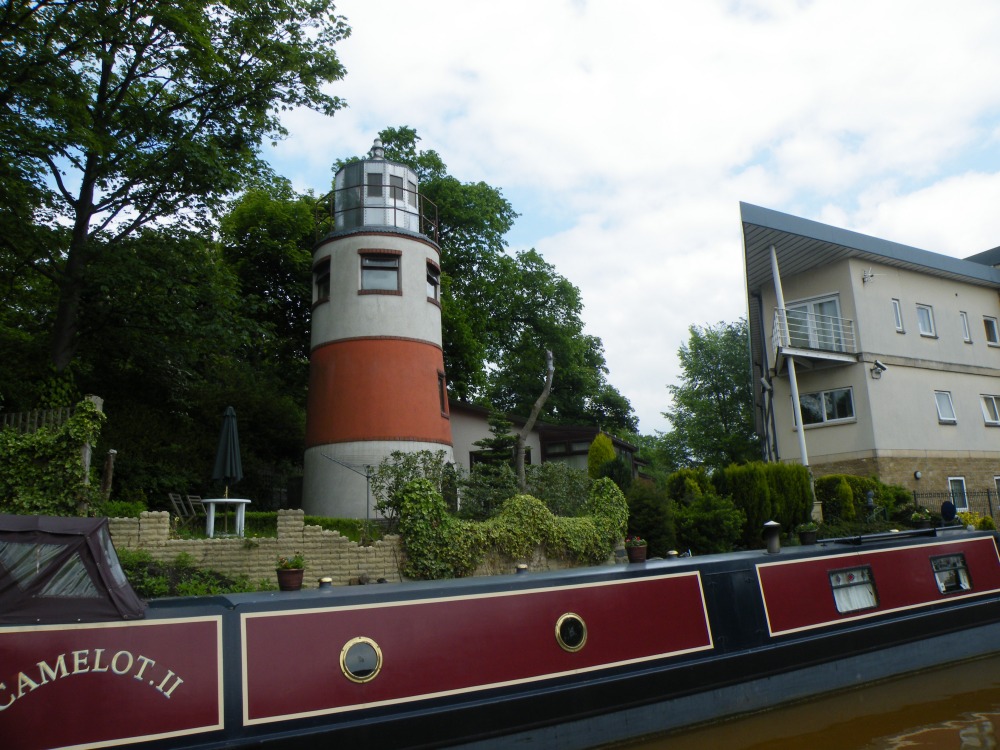
At Parrin Lane is a lighthouse.  Why I'm not sure but it is a distinctive feature of the canal.  This time past the lighthouse was especially memorable as there was a horrible metallic grinding noise and something wrapped itself round our propellor.  

We turned the engine off and Ian dived into the weed hatch.  Here at the end of the day you can see the offending object.  It was a mop with a metal handle which was securely wrapped round the propellor shaft.  This is the worst prop incident we've had so far this year.

One of the highlights of the Bridgewater Canal is the Barton Swing Aqueduct which crosses the Manchester Ship Canal.  If a ship comes along then the water channel of the Aqueduct is closed at both ends and the whole construction is swung out of the way of the Ship Canal.

Here is the view from the Aqueduct looking seawards.  The road bridge beyond the control tower also swings to clear the way for ships.

And here is the view looking towards Salford.  You can see a ship on the left. When this moves the Barton Aqueduct would need to swing.  We have met boaters who have been stopped at the Aqueduct.


At Waters Meeting a canal goes left to the centre of Manchester to join the Rochdale and Ashton Canals in  providing two of the three routes over the Pennines.  We went right on the long straight stretch of canal passing Stretford and Sale before eventually coming out into open country and mooring for the night.

In the next few days we will be working our way in a more leisurely fashion to join the Trent and Mersey Canal through Preston Brook Tunnel and on south to Northwich and Middlewich.  We are now in Cheshire and away from Lancashire where moorings are pronounced 'Merings'.

Tuesday, 24 May 2016

Back South over the Ribble Link

We reached the north end of the Lancaster Canal at Tewitfield and then there was only one way to go - back the way we had come.

This view is taken from the spectacular Lune Aqueduct, looking upstream.  The dots in the water are canoes.

As we arrived at the Aqueduct, the broad beam trip boat, Kingfisher, was turning round.  Here you can see Kingfisher crossing the Aqueduct.  


This time in Lancaster we visited the City Museum which had a special exhibition on Morecombe and Wise as well as informative presentations about aspects of local history.  Well worth a visit.

Walking back, we liked this advertising board!

As well as bluebells, we've enjoyed banks covered in wild garlic like this one by the canal.  At times it looks like snow, but certainly smells different particularly during rain, though we've had little of that I'm pleased to say.


When coming back down a canal we've already travelled, we try to stop at different places.  So it was with Galgate which was an old village with lots of small cottages built for mill workers.

This is one of two mills in Galgate.  Encouragingly these are still in use by a variety of modern businesses.  One mill (not sure it's this one) is the oldest silk mill in Britain.

This stuffed person is apparently fishing and his left hand is fixed with string to an overhanging branch, so that the wind moves his hand and makes it look as if he is waving.  A quick glance makes him look quite real.


From a mooring at Cabus Nook, north of Garstang, we had a walk up into the Bowland Forest and climbed the delightfully named 'Nicky Nook Fell'. 

Here Helen is about to join the footpath to the top of the hill.  Nicky Nook Fell is only about 700 feet above sea level but has superb views over the coast from Lancaster to Blackpool and Preston.  I guess you should be able to see the Lake District Mountains and possibly the Isle of Man, but visibility was too poor when we were there.

This monument on the Fell was originally erected to celebrate Queen Victoria's diamond jubilee, but there are now extra plaques for Queen Elizabeth's golden and diamond jubilees too.

Here is Helen on top of Nicky Nook.  The hills behind are higher fells in the Forest of Bowland, the right hand one is called Parlick Fell.

From the top we dropped down into Grizedale  which has a reservoir and some delightful native forest.  This view shows more bluebells in the woodland.

The bluebells here have flowering broom behind.


With a visit from our son, David, we carried on into the centre of Preston and moored overnight on Sunday by the services at Cadley.  This mooring is securely locked at night.

Passing a caravan site we liked this horse coming out of the ground.  It is cast in brass and beautifully finished.

We are seeing more swan families now.  Here is Mum and Dad and three cygnets.

The last half mile into Preston is rather weedy but houses adjoining the canal have worked hard to make their gardens attractive.  This one looks like a Caribbean bar.
We walked down to the Marina and Docks.  Here are Helen and David standing by the Marina.

The Ribble steam railway runs along the river front and crosses a swing bridge over the entrance to the Dock.

Since the final mile of the canal has now disappeared, this is now the very end of the Lancaster Canal.  The Canal finishes on a high embankment and originally then crossed another aqueduct.  The proposed aqueduct over the River Ribble that would have joined the canal to the rest of the system was never built.


So the Lancaster Canal remained disconnected from the rest of the canal system until, in 2002, the Ribble Link was opened.  We had come over the Ribble Link at the beginning of May and yesterday (Monday) we returned that way to Tarleton on the Rufford branch of the Leeds and Liverpool.  We've not included so many pictures this time as it would simply be repeating an earlier posting, but I will describe the experience.
Having come down 8 locks from the Lancaster Canal we followed the semi-tidal Savick Brook.  As you can see this does not look navigable!  Both Leo and the boat in front of us kept going aground as the water level seemed to be a foot or more lower than our outward trip.  At one point the boat in front got firmly stuck and we managed to give it a nudge with Leo to allow us both to continue.

Here we are cruising down the River Ribble against the tide.  You can see the buildings of Preston in the distance.  The return trip was harder work for the engine going along the Ribble (doing about 2,000 rpm) but towards the Astland Lamp the tide slackened and we rounded the lamp into the River Douglas just about at slack high water.

You do have to keep an eye open for debris floating in the River.  We had already passed a floating sofa when we came across this armchair.  With David hoping to move house soon we did think of towing these but we couldn't find the other chair to make a three piece suite!

Here you can see the Astland Lamp to the left and the boat in front just turning to go round it and up the River Douglas.  Notice that the planks and poles are tied on for this trip just in case.  We did finish up with salt spray on the bow and front windows, but it was pretty calm and the earlier wind had mostly dropped by the time we were out on the tide.
Having come round the Lamp we came up the Douglas against the falling tide.  However the outgoing tide is much slower than the incoming tide, so this was not really too difficult.  Here you can see us approaching Tarleton Lock which marks the end of the Link.  Although there was a bit of a current past the lock it was not too difficult to get in.

David enjoyed his passage over the Ribble Link with us and here you can see him on the back of Leo safely moored up in Tarleton.  And even now it is not back to work for David as he is off to Wales for a few days holiday.


Today we have cruised most of the way back up the Rufford branch and tomorrow we will return to the Leeds and Liverpool Canal heading for Wigan and Manchester.  We will broadly be heading south now but we are discussing an excursion into Wales on the Llangollen Canal.