Saturday, 1 August 2020

Up to the top of the Thames

This posting on our blog covers our journey from Oxford along the upper Thames to Lechlade where we shall probably stay a few days. Lechlade or strictly Inglesham a mile or so upstream, is the navigable limit for boats like Leo.

First some pictures of Tuesday when we spent the day touring Oxford with the benefit of a guided tour downloaded from the internet.
This is looking back at the very end of the Oxford Canal. Near the end a lock goes right giving access to the Thames and a dead end branch goes left. The picture shows the end of the branch. It used to go further to a canal basin which is now a car park. There are those who would prefer a canal basin - yes please!

This is the Ashmoleum Musuem, seen on our tour. Preferring not to go inside the buildings even when, like this one, they are open, we looked more carefully at the outsides.

Our guide seemed particularly interested in the demise of the three Oxford Martyrs - Hugh Latimer and Nicholas Ridley in 1555 and Thomas Cranmer in 1556. The cross in the middle of Broad Street marks the spot where they were burnt at the stake.

Here is another Bridge of Sighs connecting two parts of Hertford College with two Japanese tourists taking a picture under it - not many tourists about at the moment so worthy of a photo itself.

The distinct lack of tourists leads to this sight of many empty punts on the Cherwell, waiting for customers.

We made an exception to our 'stay outside' rule in the case of the Botanical Gardens where we admired these huge pitcher plants in a conservatory. They are carnivorous and with a pitcher this size any insect is fair game.

Having a Leo boat we are always on the look out for lions to photograph and found this intriguing grotesque on Magdalen College. Nobody seems to know why the king has his finger in the lion's mouth - one explanation is that the king is removing a bad tooth from the lion's mouth but, whatever the reason, it doesn't seem a very good idea to us.
 On Wednesday we left Oxford:
We filled up with diesel and set out on the river. In this picture we are going down in Isis Lock which leads to an insignificant backwater called the Sheepwash Channel which in turn connects with the Thames.

The route to the river goes under several railway bridges close to Oxford Station, including a swing railway bridge which is no longer used.

Here you see Leo cruising past Port Meadow which we had walked round on Monday. We are now heading upstream. The east side of the river, here on the right, is very shallow so you need to stay in the middle.

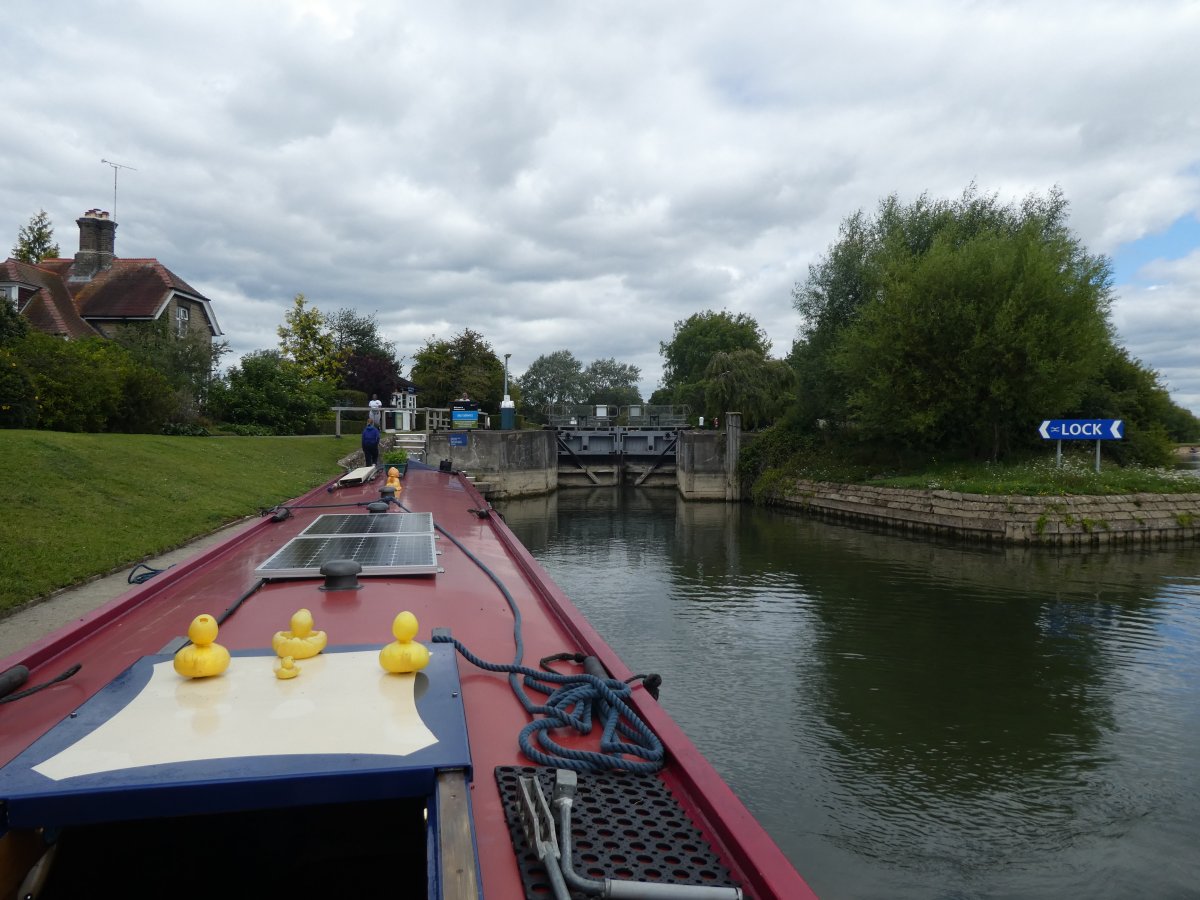
The first lock is Godstow. Many of the Thames locks are manned, particularly in the lower reaches, but this one wasn't. We met a lockie at the next lock - King's Lock - and asked about buying a visitor licence for the Thames, since you used to be able to do this at the locks. Covid has changed all this - you now have to order and pay for a licence over the phone. We have a licence now, but we do wonder if all the visiting boats have done this.

Here we are going into Eynsham Lock (which was also manned) with a boat called 'High Hopes' which is now moored in front of us at Lechlade.

This rather uninspiring little craft has strong memories for us. In 2012 when we were caught in floods on the Thames at Wallingford, this tug called Tungsten towed our boat and our son's narrowboat, Pas Meche, up the river for miles to the Oxford Canal where we were able to escape the flood after 11 days trapped at Wallingford. Tungsten was skippered by a very laid back chap called Steve. As well as paying him for the service, we left a crate of beer onboard Tungsten after we were rescued.

Pinkhill Lock is delightful and was our last lock on Wednesday.

We moored on a field below Farmoor Reservoir just above the lock and walked back later to look at the flowers. Many of the Thames locks are kept beautifully and this is no exception.

We walked quite a way on the other side of the river and gently up to Sutton and Stanton Harcourt. Sutton has lots of thatched cottages like these and Stanton Harcourt has fine stone houses and a tower known as 'Pope's Tower'. This has nothing to do with the Pope, but refers to Alexander Pope who apparently translated the Iliad when staying in the manor house here. The tower is on private land and we could not get a good picture of it.

On Thursday we travelled further up the river and this is Northmoor Lock. All the Thames locks so far have worked perfectly.

There are few bridges over the Upper Thames but this one is called Newbridge and has a pub on either side of the river.

Here Helen tackles some of the really twisty bends on the way to Shifford Lock. Now we've got to Lechlade we'll be able to rest our arm muscles.

Egrets seem to be getting more common. This one was part of a flock of six or so birds by the river. It is a Little Egret but we have also seen Great White Egrets which we've read probably fly over from France.

The parasols made us think that Radcot Lock was manned but it wasn't so it was nice that they had arranged for some shade for Helen on what yesterday (Friday 31st) was a very hot day.

We passed two groups of swimmers shepherded by boats. These were the pink hats group. The river has been busy with paddleboarders, canoes, swimmers and people jumping in. Some enterprising lads were jumping in the water from a second world war pill box alongside.
We've been up here before but we don't remember the many aircraft flying over. We think these come from Brize Norton a bit further east. Perhaps they were training pilots as the planes seemed to go round in anti-clockwise circles. What they'll do if they want to fly clockwise, I don't know!

At St John's Lock, which is the last on the Thames, is Old Father Thames shown here. The statue used to be close to the source of the Thames but was subject to vandalism and was brought here, where he has been given a spade.

This is just to show you that we also went swimming in the river after we had arrived at Lechlade. Many youngsters were in the water but when it had cleared a bit, the oldsters went in and we relearned the skill of climbing back on the boat afterwards to avoid the sticky gluey mud at the water's edge. Following our example the skippers of the boats either side of us went in too. So did Ian - but no picture.

There are lots of swans here and one seems particularly aggressive, that is more aggressive than this aggressive animal normally is. Fortunately the horrid one seems to attack other swans rather than humans.
After a blistering hot day (34 degrees was forecast and the cabin temperature hit 38), the evening cooled down. We walked up to the Roundhouse where a selection of ambulances and police cars were attending to pick up the casualties from a drunken fight among youths from Swindon. No such problems on the field where we are moored - just families with children and boaters. Oh and a farmer who knocked at the ridiculous hour of 8.30 am this morning to ask for his £5 mooring fee.

We've stayed put today (Saturday 1 August) and may stay tomorrow too. But then we'll be off downstream again.But more about that in the next posting.

Tuesday, 28 July 2020

All the way to Oxford - river navigation and strange shaped locks

We arrived in Oxford yesterday and this posting describes our trip down the last of the Oxford Canal and into the city over the last few days.

On Thursday (23rd July) we went under Haddon’s Lift Bridge. South of Banbury, there are innumerable lift bridges but fortunately most of them are left in the raised position like this one.

Here we are waiting for our turn to go into Nell Bridge Lock. In the pound below here the canal crosses the River Cherwell, not by means of an aqueduct but on the level so that the river flows into the canal on one side and out the other. If the river is high this stretch can be unnavigable. It wasn’t when we passed.

Less than a mile further on is Aynho Weir Lock and the picture shows Leo waiting for this lock. The River Cherwell flows out of the canal under the arches on the right. If the river is running fast boats can get pinned against the arches.

Here the Cherwell is flowing into the canal from the other side.

Aynho Weir Lock only falls about 2 feet (but can vary depending on the river level). In order to supply enough water further down the canal it has a curious diamond shape so that although the fall is small, the volume of water is much greater.

This is Somerton Deep Lock, at 12 feet, is the deepest on the Oxford Canal. There was quite a queue of boats here waiting to go down the lock. Because it is so deep it takes longer to fill and empty and so causes a hold up but gave us plenty of time to exchange news with other boaters which we find is one of the joys of canal life.

This is looking down the canal from the bottom gate of Somerton Deep Lock. You can see the lock beam of the open gate.

And here is Leo down the bottom of the lock with some of our new friends opening the gate for us .

We spotted this tiny greenhouse at Somerton.

We moored on Thursday in open fields at Somerton and went for a walk into the village. Having a boat called Leo we are always on the lookout for lion related objects and found this lion face on a corbel in Somerton Church.

We spent an extra day at Somerton mostly doing jobs on Leo and enjoying the lovely open mooring by a large field running down to the Cherwell. On Saturday we carried on through Upper and Lower Heyford and met these two large boats below Heyford Common Lock – a motor towing a butty. As Helen opened the lock gate to let Leo out, the way ahead was blocked by the motor and the canal further on by the butty. However the boats had plenty of crew and all was sorted out with good humour and no delay.

This huge tithe barn is close by the church at Upper Heyford.

This lift bridge at Heyford was not kept in the open position but fortunately it is powered so Helen was able to open it with just a turn of the CRT key. The other two people are not leaping into the water but are magnet fishing which seems to be getting more popular. Tie a strong magnet to a rope and throw it into the canal and see what comes up.

This is taken from the bridge at Heyford Wharf and shows how close the railway and the canal are here with even a handy station right alongside the canal - and a hire boat base on the right.

On Saturday the rain came down in the afternoon and we stopped above Pigeon Lock to have lunch and get out of the rain. The rain stopped later so we walked into Tackley where we found this Tithe Barn on a green in the village. There is a small shop in the village which stocks local produce and looked good but it is only open in the mornings. The rain returned  soon after we set out but we had boots, waterproofs and umbrellas so we stayed dry.

Unusually on Sunday we had an appointment as we had arranged with our friends Stephen and Margaret to meet at Thrupp for tea in the afternoon. Part of the route to Thrupp involves one section where the canal and the River Cherwell are one and the same. Having come down Baker’s Lock we joined the river. The view here is looking back to where the river comes under the curved bridge with the channel to Baker’s Lock on the right where you can just see a blue boat moored.

Here we are out on the Cherwell. We passed a quite a few people in canoes and some were swimming in the river. The river goes round some very tight bends and we met a couple of other boats on this section.

We left the river at another strange diamond shaped lock – Shipton Weir Lock. As before this increases the volume of water in a lock which has a very small rise and fall in order to provide enough water for the larger locks further along the canal.

Thrupp is a lovely spot and here we are cruising through it. There is a sharp right bend and another electric lift bridge. Beyond this are some public moorings if you are lucky to find them empty. We have passed this way before and never found space but this time our luck was in and we moored right outside the Boat Inn where we enjoyed a Sunday roast lunch before our friends arrived in the afternoon. It was good to catch up with them by a socially distanced tea with us on Leo and Stephen and Margaret sitting on chairs on the bankside.

On Monday we reached the end of the Oxford Canal by arriving in the city. On the way we came through Roundham Lock where some CRT engineers have found a novel way to repair the bottom gate with lengths of sheet piling and a ladder arrangement of beams to replace a broken gate beam. The gate really is in a sorry state as it also has one paddle bandaged up in yellow tape to show that it is broken and out of use.

There are two routes to the Thames from the Oxford Canal. We passed the first which is called the Duke’s Cut below Duke’s Lock shown here. Our aim was to continue into the city and enter the Thames a few miles downstream.

Here you can see the Duke’s Cut going under the bridge. Having come down one lock, the Duke’s Cut then goes up another lock to reach the level of the Thames at this point.

We found moorings surprisingly empty in Oxford and moored close to Isis Lock which gives access to the Thames. We plan to stay here a couple of nights. There was more rain today but after it stopped we went for a walk on Port Meadow -  a huge flat area of land by the side of the Thames. The picture of the Thames looking downstream from Port Meadow shows Bossom’s Boatyard to the left and the route towards London is under the bridge to the right.

A couple of red kites were soaring on the strong wind above the meadow and I was able to get this picture as we sat on what is called “Round Hill”. Anything less like a hill it would be difficult to imagine but it is circular and it does – just – rise above the surrounding very flat meadow. It is apparently a Neolithic burial mound which explains why it is there. The red kite is clearly missing some tail feathers but seemed to be enjoying soaring on the wind currents nevertheless.
Today we enjoyed a day of sightseeing in Oxford where, at least in the morning, there were remarkably few people about. But you will have to wait for our next posting to see some of the pictures of the city. Our plan from here is to go up the Thames to Lechlade which is the navigable limit. With the forecast being for a spell of hot weather it will be good to be able to swim off the boat in the river if we need to cool off.

Wednesday, 22 July 2020

Going downhill towards the Thames via Banbury

We are moored tonight (Wednesday 22nd) just south of Banbury heading for Oxford. It has been a few days since we crossed the summit level of the Oxford Canal and we are now descending gradually towards the Thames Valley.
The summit level of the canal is very twisty and on the southern section just before the descent towards Oxford there are a couple of feeders that supply the canal with water from nearby reservoirs. Every time that a boat crosses the summit it takes two lockfuls of water - one on the way up and one on the way down - and this water has to come from somewhere. The picture shows the towpath crossing the feeder from Boddington Reservoir. What is noticeable is how clear is the water coming in compared with what is already in the canal.

Eventually on Monday we came to a queue of boats waiting to descend the five Claydon locks that lead down off the summit level.

We dropped down 2 locks and then moored to wait for the arrival of our son David, shown in the photo with Helen. David came to visit us for a couple of enjoyable days and he brought the sunshine with him.

Note the plastic duck with ribbon on the bollard. We have a collection of plastic ducks on Leo each of which has been rescued from a canal or river. This particular duck was rescued in 2012 from this very lock - Cropredy Lock. As a result we always give him an option to go back in this lock when we are passing. As on previous occasions he decided to stay with us.
As you can see David is still smiling after helping us down the locks to Cropredy.

This unusual narrowboat is called Sue Perb and is owned by two ladies who have written a number of articles for Waterways World, describing themselves as the Windlasses. We've seen the boat before on the Leeds and Liverpool Canal at Burnley but this is the first time they were onboard and we were able to say hello.

Here is an unusual way to fill the canal!

This is Hardwick Lock on the way from Cropredy to Banbury. David is on the right and helping with the lock.

And here we are in the centre of Banbury. We moored just outside the centre at Spiceball Park and walked in. You can see a new building surrounded by scaffolding. There are two large redevelopment sites either side of the canal. The sunken boat on the left is an old wooden narrowboat that is waiting to be restored by Tooley's Boatyard. Tooley's is famous as the place where Cressy was altered to become a cruising boat for LTC Rolt one of two pioneers who together started the process of saving the canals for leisure use.
Banbury is an historic market town with some fine buildings and was the childhood home of a friend of ours. This picture shows the Banbury Cross from the nursery rhyme, though in fact the cross is a Victorian replacement of the original.

And here is the "fine lady upon a white horse". A rather fine bronze representation with some interesting extra features to look for, like the butterfly on the flower garland around her head.

Banbury has a number of spandrels - iron sculptures above some of the narrow lanes. Usually these are arches joined to the buildings either side, but this one was only fixed on one side. It is one of four on Butchers Row showing local trades and celebrating Banbury as an important market town. This one has three animals hanging from rings are a sheep, a pig and a cow and could be for a farmer or a butcher.

This early Victorian building advertising its wares has been recently restored.

We said goodbye to David yesterday so today (Wednesday) we carried on with just the two of us. After a hard morning's shopping we took Leo through the centre of town and in the picture we are waiting to go down Banbury Lock.
After a morning session shopping in Banbury we left the town after lunch and enjoyed a good view of tedding and baling in the fields outside the town.

South of Banbury there are lots and lots of lifting bridges like this one. Fortunately they are mainly left in the open position for boats so don't have to be raised to go under them. You might wonder how a pedestrian closes the bridge if they are on the side away from the pivot. Generally, but not always, there is a rope or chain hanging down to enable the user to pull the bridge down to use. They are finely balanced and not to hard to move.

This is Kings Sutton Lock which at 10 feet 8 inches is the deepest we've met so far. Unfortunately the bottom gates leaked so badly that we had great difficulty in getting the lock to fill to let us in even with the top paddles fully open. Two athletic canoeists turned up and helped us get the gates open for which we were very grateful. We are moored below the lock tonight. Apart from the noise of the M40 this is a pleasant and remote mooring with views of cows opposite.
Apart from round Banbury the Oxford Canal is very rural and pleasant and we are enjoying a spell of fine summer weather, so all is definitely well with us. The next few days will see us gradually dropping down the valley of the River Cherwell towards the Thames.