Tuesday, 1 October 2019

Canal Cruising in the Rain!

Well it has been a bit wet just lately hasn't it? It is now a wet afternoon to follow an amazingly wet morning so it is time to tell you where we have got to. In summary we have come south on the Trent and Mersey and have turned off onto the Coventry Canal at Fradley Junction. We are moored close to Springhaven Marina on the edge of Nuneaton as we are having some new solar panels fitted there tomorrow. So here is a catch up starting from Great Haywood Junction.
At Great Haywood we joined the Trent and Mersey Canal heading south. There are two locks here going down to follow the valley of the River Trent. This is the second and is called Colwich Lock.

Through the trees below we could see Bishton Hall, shown here, which is now a school. We saw some pupils out tending to ponies in the grounds.

We've noticed that the sweet chestnut trees are very prolific this year. Lots and lots of chestnuts for harvesting later in the year. They are not yet ready for eating or we would have gathered some to roast on the stove on Leo.

Approaching Rugeley the canal crosses the River Trent on an aqueduct. The river looked pretty full after the rain and we've heard since that it is closed to navigation further downstream. Rugeley is a useful town for shopping and has an excellent hardware shop, something that is becoming quite rare. So patronise it now.

On Saturday our son, David, and his partner, Ash, drove up to see us and helped us down two of the Fradley Locks. This is Shadehouse Lock, the top one of five that descend through Fradley. Two locks down is the junction with the Coventry Canal.

Fradley Junction is probably one of the most photographed sights on the canals. Here we are below the two locks with the Swan pub on the left and the turn onto the Coventry Canal to the right. The bywash around the locks was cunningly reconstructed to by pass the junction when the Coventry was built so that the Coventry Canal would not steal water from the Trent and Mersey.

Here is Leo turning onto the Coventry Canal. So how did we get this picture?  Well David walked round and took some photos of us turning the corner.

And he was then handy to open the swing bridge just round the corner! The white building opposite the junction is The Swan at Fradley.

David and Ash took turns steering Leo along the twisting course of the Coventry Canal as far as Huddlesford where we moored. We ate out with our visitors at the Plough which has excellent food and good beer.

When we set off on Monday we soon passed a junction with a short arm now used for moorings. This used to be the Lichfield and Hatherton Canal which led to the north of Birmingham and on to Hatherton on the Staffs and Worcs. We had seen the other end of this canal a few days ago. Work is planned to restore it and there is a purpose built but isolated aqueduct over the M6 Toll road. One day, hopefully, it will all join up.

This stone by the canal marks the point in Whittington where the Birmingham and Fazeley Canal meets the Coventry. A brief explanation is needed. We tend to regard the section of canal between Fradley and Fazeley Junctions as being the Coventry Canal. The truth is that the project to build the Coventry Canal ran out of money so the final section was completed by the Birmingham and Fazeley to Whittington and by the Trent and Mersey from there to Fradley. The Trent and Mersey's bit was later bought out by the Coventry Canal company.  All very complicated and sensible now just to call the whole lot the Coventry Canal.

Here, in the rain, is Fazeley Junction where the Birmingham and Fazeley Canal goes under the bridge towards Birmingham. We stuck to the Coventry Canal heading south to Tamworth and Nuneaton.

Soon after Fazeley Junction the Coventry Canal crosses the River Tame on an aqueduct. This river too looked full to overflowing.

Not far beyond the Tame the two pretty Glascote Locks lift the canal out of the valley. Notice the waterproofs and umbrella not to mention the wet roof on the boat.

We moored not far above the Glascote Locks on Sunday and on Monday (30th September) we carried on into Atherstone passing the boatyard at Alvecote on the way.  This marina cum boatyard has quite a few old working boats including the three shown here.

Grendon Wharf comes after the canal goes through Polesworth where the well kept gardens backing onto the canal distracted us. Monday morning was sunny as the pictures show but the afternoon was again pretty wet. We moored part way up the Atherstone flight of 11 locks. 
Here is Leo waiting below Atherstone bottom lock.

We enjoyed the Atherstone Locks. This one, lock 10, is our favourite with an old lock beam as a seat and views of the flooded countryside beyond.

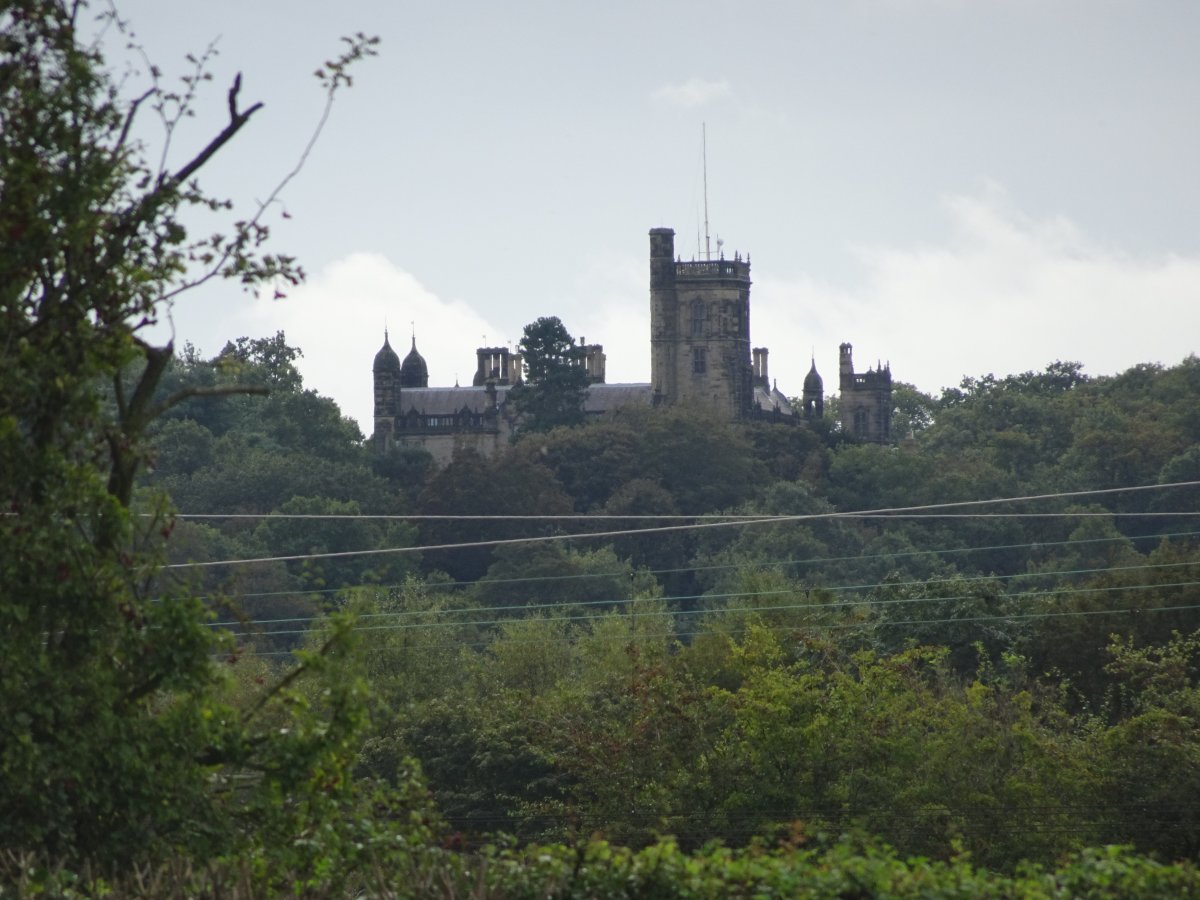
The first six locks come in pairs so we climbed up four and then moored before getting into the town. In the distance we could see what looked like a castle and the zoom lens and the map identified this as Merevale Hall to the west of the canal.

Atherstone is a pleasant small town with all necessary shopping. This photo is of Market Square but it was not market day so no stalls. The archway under the white building to the left is not just a way into the yard but is a road through the town.

Today (Tuesday 1 October) we came up the remaining 7 locks of the Atherstone flight. The first three we managed in the dry but then it came on to pour and this is the wet view looking back to the top lock. Three volunteers were helping boaters on the flight and taking shelter in a hut at the top lock when they could. This picture does not show it, but there are lovely flower beds around the top lock and basin lovingly tended by the volunteers.

Later we passed Hartshill Yard. It is most attractive and was used as a base by British Waterways.It may now be used by Canal and River Trust, but no boats were there today.

The overspill weirs have been running hard today to shift the excess water after all the recent rain and in some places torrents of water were pouring into the canal. The canal has turned brown and muddy even before it is stirred up by boats.
So that brings us up to date. Apart from getting solar panels fitted tomorrow, we are aiming to go up the Ashby Canal before heading on more directly to our winter mooring south of Leicester. Lets hope the weather picks up.

Friday, 27 September 2019

Two old canals on the Staffs and Worcs

Having come south down the Shropshire Union we then turned left going north again on the Staffordshire and Worcestershire Canal as far as Great Haywood. So this posting is about a few days on the northern section of the Staffs and Worcs:
We moored on Monday (23rd September) at Hatherton. This was once a canal junction with what is now called the Lichfield and Hatherton Canal and used to connect with the Birmingham Canal Navigations, and might one day do so again. It would provide an alternative route to Huddlesford on the Coventry Canal where we aim to be tomorrow evening. We took our bikes and explored the remains of the first part of the Lichfield and Hatherton. This view is looking from the first bridge towards the junction with the Staffs and Worcs. Leo is moored just out of sight to the right from the junction.

From the junction we cycled under the M6 and soon came to this bridge which is over the course of the old canal. The water still flows towards the Staffs and Worcs and the L&H still acts as a feeder.

Further on the road crossed this bridge over the old canal. The low headroom suggests the bridge has been lowered and, although it doesn't show up in the photo, some of the bricks looked as if they were part of an arch bridge originally.

Here, near Four Crosses, the canal crosses under the road by means of a sump, so there is no navigation at all at this point.

On a wet Tuesday morning we carried on to Penkridge. This picture shows Gailey Lock which is the first lock down from the summit level of the Staffs and Worcs. The round house allowed the lock keeper to see boats coming. There is now a tempting souvenir shop on the ground floor.

In Rodbaston Lock later that morning Helen rescued a toad that was trying to get out of the lock.

The canal twists through the village of Penkridge dropping down two more locks. There are good pubs and shops including a bakers where we bought delicious pies and cakes. This view is of a cottage (left) and the old gaol (right) which is open a couple of days a week, but not on Tuesdays.

Here we are on Wednesday morning heading into Penkridge Lock.

"I don't believe it" in Victor Meldrew tones comes to mind at this sign above the lock at Penkridge!

We moored on Wednesday evening close to Acton Trussell and went for a walk. It started out cloudy but the sun soon came out and we had to carry all our excess clothes. The rain we've had recently has swollen the rivers. This is a very full River Penk.

Thursday we stopped briefly close to where the Stafford Canal Link once allowed boats to lock down from the Staffs and Worcs onto the River Sow and into the centre of Stafford a couple of miles away. After the rain stopped we walked to where work continues on restoring this link. The plan is to reinstate a canal basin here and at the far end away from the camera a narrows will lead to an aqueduct over the River Penk into the River Sow which leads to Stafford.

And by the side of the canal basin the footings have been built up where the lock keeper's house used to be.

The valley where the Penk and Sow meet was quite flooded and we saw cows wading belly deep through the floods. Apparently this is normal after a few days of heavy rain.

This wall is alongside the Staffs and Worcs and you can just see where the parapet rises where a bridge used to cross over the Stafford Canal link.

This sign has been installed by the junction. River Canal Rescue (the boaters' AA or RAC) do in fact have an office here and perhaps they sponsored the sign.

Here is a turnover bridge where the towpath changes to the other side of the canal. Turnover bridges with spiral ramps were designed so that a horse towing a narrowboat could cross the canal and continue towing without the rope having to be detached.

Here is we are waiting for the small lock (only a four foot fall) at Tixall. Even on a gloomy day it was still pretty.

Tixall Wide is an expansive stretch of water crossed by the canal. It was not an existing lake that was used by the canal builders but was built with the canal to enhance its appearance from the big house nearby. It is a good place to moor but we decided to carry on to Great Haywood.

The big house for which Tixall Wide was built has now gone but the gatehouse shown here can be seen across the fields.

On the left after an aqueduct over the River Trent and just before the junction is a large Anglo Welsh hire boat base. Beyond the bridge is the Trent and Mersey Canal.  Left leads to Stoke on Trent but we turned right heading for Fradley.

Having moored just round the corner on the Trent and Mersey we walked into the Shugborough Estate, once the home of Patrick, Earl of Lichfield. The route there leads over Essex Bridge which crosses the River Trent just beyond its confluence with the River Sow. In the photo the Trent is to the right and the Sow in the middle. To the left is an artificial channel that runs from the Sow through ornamental lakes as part of the formal gardens of Shugborough Hall. The Trent was running brown and muddy but the Sow was clear.

We had a look round the house. This is the ceiling of the Red Dining Room.

Brothers Thomas and George Anson made a number of improvements to the house. George was a renowned admiral who circumnavigated the world in 1740-44 and came back with plentiful plunder and a keen interest in architecture and art from around the globe. He had this Chinese House built on the estate after his voyage.
So now we are on the Trent and Mersey Canal which we have not seen since we left it at Middlewich quite a few weeks ago. Our aim now is to go south once more for a short way to Fradley Junction where we will turn onto the Coventry Canal. We still have a couple of weeks cruising to look forward to before we set down our windlasses for the winter.

Tuesday, 24 September 2019

The southern end of the Shroppie

This posting covers the last of the delightful Shropshire Union Locks and our travels along the rest of the Canal to Autherley Junction where it meets the Staffordshire and Worcestershire Canal. So we start with Tyrley Locks, the 5 locks coming out of Market Drayton heading south.
Below the first of the Tyrley Locks is a rock cutting that makes you wonder why the final lock wasn't put in a little further north to keep the canal closer to the natural lie of the land.

Having gone up two locks, the third took us out of the rock cutting into the sunshine as we climbed the middle lock.

Here we are coming up to the top lock.

The buildings around the top lock create a classic and widely recognised canal view. We have four little pictures in the saloon on Leo of well known canal views and one is of Tyrley Top Lock.

This little boat seen moored above the Tyrley Locks must be a contender for the smallest narrowboat on the canals!

Above the Tyrley Locks is one of the deep and narrow cuttings that the Shroppie is famous for. This one is Woodseaves Cutting. It must have taken a lot of picks and shovels to dig it out.
A few miles after the cutting is this factory which used from 1911 to 1961 to produce chocolate 'crumb' using local milk which was then transported by canal boat to Cadbury's factory at Bourneville just to the south of Birmingham.


Beyond the factory is the Shebdon Embankment where we moored for the night on Friday (20th September). On Saturday we came off the embankment into Grubb Street Cutting where this bridge (called High Bridge) forms probably the most recognised view of the Shroppie. You will see that there is a horizontal strut in the bridge arch and on top is a mini telegraph pole. It no longer carries wires but it is such a well known sight that it is preserved.

On Saturday we stopped at Norbury Wharf shown here for diesel. At 76p a litre it is one of the cheapest places on the system to fill up and one of the prettiest!  Beyond the two boats moored on the left is a towpath bridge over an arm now used for boat repairing. This used to be the Newport Branch heading towards, you've guessed it, Newport.

Gnosall is a pretty village a couple of miles south of Norbury Junction and then the canal goes through its only tunnel at Cowley.  It is very short at 81 yards but the tunnel and the cutting either side is cut through solid rock.  It was designed to be 690 yards long but the rock was so unstable that the tunnel was opened out as a cutting for much of its length.

We moored on Saturday out in the countryside and, after a couple of hours servicing the engine, we walked into Church Eaton which proved to be yet another delightful place.

On Sunday and with a change in the weather, we went into Brewood crossing the Stretton Aqueduct shown here. It crosses the A5 and represents one Telford transport project crossing another.

Isn't it wonderful how those Victorian architects embellished their creations?  The carved columns on the aqueduct really add to its appearance.

Here is a view looking down to the A5.  Not much traffic as this section is by-passed by the M54 as far as Telford.

The canal passes through Brewood (pronounced 'Brood') in a deep cutting. We climbed up steps out of the cutting to do some shopping and to visit the Bridge Inn for Sunday lunch. Our timing for lunch was perfect as it rained fairly hard while we ate and then stopped to let us explore the village. As we don't like mooring in gloomy cuttings we carried on out of the village after lunch passing this view across fields to Brewood Church.

We moored a couple of miles south of Brewood where our zoom lens could pick up the blocks of flats in Wolverhampton. We've been noticing Midlands accents for the last couple of days so we can now say that we are no longer in the north.

On Monday we came down the last 3 miles of the Shroppie to Autherley Junction. The Staffs and Worcs Canal is just beyond the bridge and we turned left heading towards Great Haywood. Leo is sitting in the stop lock just before the junction. This lock raises the level only a few inches and seems pretty pointless until you understand the need for the Staffs and Worcs Canal not to lose all its water down the 'new' Shropshire Union Canal, hence the expression 'stop lock'.

Here's the view looking back along the Shroppie past a boatyard where the Napton hire boats belong.

This is the sign at the junction. We have come from the direction of Chester and we are now bound for Great Haywood. Stourport is where the canal meets the River Severn.

Here, looking back, is the shapely bridge over the start of the Shroppie.
Oddly having come south along the Shroppie our way is now north along the Staffs and Worcs. But canals seldom lend themselves to direct journeys. We could go via Birmingham but we have decided to avoid that and all the extra locks. Until you've been through Birmingham on a canal boat you don't realise that it is on top of a hill.

So what did we think of the Shropshire Union Canal? Lots of people seem to love the Shroppie but it is really not one of our favourites. We like canals that meander across the countryside whereas the Shroppie goes in pretty straight lines making use of huge embankments and deep cuttings to achieve this. The Shroppie was built much later than most of the other canals and it is more similar to a modern motorway. It might be a good idea for the speedy carriage of goods but that is not what attracts us to the canals. When we are on top of a big embankment or down in a gloomy cutting (one of our pet hates) we feel separated from the countryside and the rest of the world rather than part of it. Having said that, the flights of locks are a delight.